Module 5/Lesson 1 of 5
Left & Right Turns
How to safely execute left and right turns at intersections, including turns on red lights and from different road types.
Before You Turn
Any time you plan to round a corner, reverse, switch lanes or reverse your direction, you first have to understand what sits alongside and behind your vehicle. Make a habit of checking your mirrors and glancing over your shoulder so you can confirm the path is open and that you have room to finish the manoeuvre without risk.
Turning a Corner -- General Technique
Rounding a corner step by step:
- Signal early, well ahead of where you intend to turn
- Once the path is open, position yourself in the correct lane -- for a right turn that means the far-right lane, while a left turn calls for the far-left lane on your side
- With your signal on, scan left and right and verify your blind spots are clear
- Ease off your speed before entering the turn -- a tighter corner calls for going slower
- Complete your braking ahead of steering so you keep the vehicle fully under control
A tight corner calls for "hand over hand steering": rotate the wheel with one hand while crossing the other hand over the top. Take hold of the wheel on the far side and keep rotating. Once you have finished, ease your grip and allow the wheel to feed back toward centre.
Avoid steering with a single finger or with your open palm. Build your speed back up gradually as the turn finishes.
Tip
Wrap up your braking before you start steering. Drivers frequently skid and lose control because they attempt to brake and steer in one motion.
Right Turns
Except where signs or pavement markings direct otherwise, both the start and finish of a right turn should hug the right edge of the road.
Making a right turn:
- Signal in good time and slide into the right-hand lane once the way is open
- Where that lane is unmarked, stay tucked as far right as you can
- Scan ahead, then left, right and left once more before you begin
- If no smaller vehicles or pedestrians have come into view, check your right rear blind spot
- Allow cyclists, limited-speed motorcycles or moped riders to clear the intersection ahead of you
- When it is safe, complete the manoeuvre by settling into the right-hand lane on the road you are joining

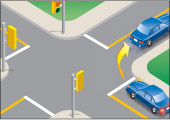
Right Turn on a Red Light
So long as no sign prohibits it, turning right at a red light is allowed, provided you:
- Come to a full stop first
- Hold until the path is open
- Signal the turn and give way to pedestrians and anyone else using the road
Important
A right turn on red is allowed unless a sign says otherwise, but you MUST stop completely first and give way to every pedestrian and vehicle.
Left Turns -- General
Unless signs or pavement markings indicate otherwise, a left turn should both start and end in the far-left lane on your side of the road.
Making a left turn:
- Put your signal on early
- Slide into the far-left lane once it is clear
- Scan ahead, behind, then left, right and left again, checking your blind spots
- Turn only when the path is open
Important safety rule: While stopped at an intersection and waiting for oncoming traffic to thin out, keep your steering wheel straight rather than cranking it left until you are actually able to turn. If your wheels are already pointed left, being struck from behind could shove you straight into the path of approaching vehicles.
Warning
Hold your wheels pointing straight while you wait to turn left. A rear-end hit with the wheels already cranked left could send you into oncoming traffic.
Left Turns from Different Road Types
Two-way road onto a two-way road: Begin from the lane nearest the centre line and arc smoothly into the lane just to the right of the centre line. As soon as it is practical, ease over into the right curb lane.
Two-way road onto a one-way road: Start in the lane next to the centre line and finish in the left curb lane.
One-way road onto a two-way road: Set off from the left curb lane and land in the lane immediately right of the centre line, then shift into the right curb lane when you can.
One-way road onto a one-way road: Move from the left curb lane into the left curb lane.

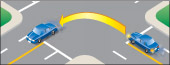
Left-Turn Lanes
Certain roads set aside dedicated lanes for left-turning vehicles. Where those lanes are painted on the pavement at an intersection, turn from the marked lane and hold that lane position as you move onto the cross road.
On some roads, the middle lane doubles as a two-way left-turn lane, giving drivers turning left from either direction a place to wait that keeps through traffic moving.
Using a two-way left-turn lane:
- Signal and ease into the centre lane just before you turn, then reduce speed.
- Roll forward cautiously until you are across from the road or driveway you are aiming for.
- Complete the turn once the path is open.
Keep in mind: drivers heading the other way rely on this same lane to turn left too. When one of them is waiting ahead of you, your view of oncoming traffic can be obstructed. These lanes are never meant for passing.

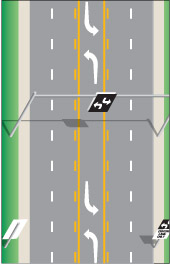
Left Turn on a Red Light
A left turn on a red light is permitted only when going from a one-way road onto another one-way road, and only after you:
- Come to a full stop
- Confirm the path is open
- Give way to pedestrians and traffic
Important
Left turn on red is ONLY permitted from a one-way road onto a one-way road. You must still stop first and yield.
Turning Around Smaller Vehicles
At intersections, motorcycles, bicycles, limited-speed motorcycles and mopeds make left turns using the same approach as bigger vehicles.
When you are turning left behind one of them:
- Don't draw up alongside it and try to turn together
- Hold your position behind and turn once the path is open
- Let the smaller vehicle pull to the right before you move past
Key takeaways
- Signal well before turning and move into the correct lane early
- Complete your braking ahead of steering into the turn so you don't skid
- Right turn on red is allowed (unless signed otherwise) after a complete stop
- Left turn on red is ONLY allowed from a one-way road onto a one-way road
- Keep wheels straight when waiting to turn left to prevent being pushed into oncoming traffic
- Two-way left-turn lanes are not for passing; vehicles from both directions use them
- Always check blind spots for cyclists before turning right