Module 5/Lesson 2 of 5
Roundabouts
How to approach, enter, navigate and exit roundabouts safely, including lane choice and special situations.
What is a Roundabout?
A roundabout is a ring-shaped intersection in which vehicles circulate counter-clockwise around a central island. Today's roundabouts feature a tighter inscribed circle along with splitter islands at the entries, both of which keep speeds down.
A few parts of Ontario still have the older style of "traffic circle". Those are bigger, permit faster speeds, and require drivers to merge and weave. The modern roundabout design is built to be safer.

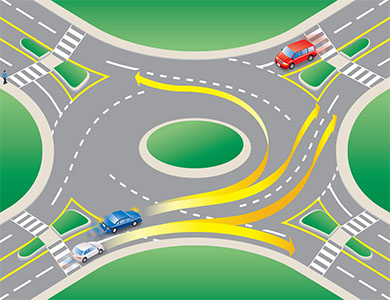
Approaching a Roundabout
On the approach:
- Read the signs to pick your exit
- Select your lane just as you would at any other intersection:
- Take the left lane if you are turning left or carrying on straight
- Take the right lane if you are turning right or carrying on straight
- Never enter from the right lane when your plan is to turn left
- Cyclists usually ride in the middle of whichever lane suits them, or get off and cross as a pedestrian would
- Reduce speed and watch for people on foot as you near the yield line at the entrance
- Hold your lane

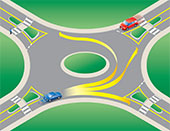
Entering a Roundabout
As you enter:
- Visual checks: Scan every vehicle already circulating plus any that are waiting to come in, cyclists included
- Look left: Circulating traffic holds the right-of-way. Give particular focus to anything on your left, slowing or coming to a halt at the yield sign whenever the situation calls for it.
- Adequate gap: Wait for a safe chance to join, entering only when the flow leaves a big enough opening. Avoid pulling in right beside a vehicle that is already inside, since it might be leaving at the very next exit.
- Travel counter-clockwise: Stay to the right of the central island at all times
- Keep moving: Once you are circulating, the only reason to stop is to prevent a crash. You outrank entering traffic for right-of-way, and you should never switch lanes inside the roundabout.
- Should you overshoot your exit, simply carry on around until it comes up again

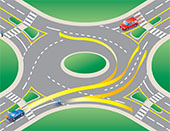
Important
Vehicles already circulating hold the right-of-way, so give way to anything on your left. Overshoot your exit? Keep going around -- don't stop or back up.
Exiting a Roundabout
As you leave:
- Signal that you are exiting and keep an eye out for pedestrians
- Stick to your lane: remain left if you came in by the left lane, or right if you came in by the right lane
- Hold your spot relative to the vehicles around you
- After you pass the exit just before yours, switch on your right-turn signal
- When leaving from the left lane, stay alert for vehicles on the right that are still going around

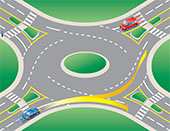
Special Situations at Roundabouts
Large vehicles: Leave additional space beside trucks and buses, which may have to swing wide either on the approach or once inside the roundabout. The driver of such a vehicle might require the entire width of the road, including the apron (the mountable strip of the centre island) where one exists. Before entering, a large vehicle may have to take up both lanes, so give it lots of space.
Emergency vehicles: When an emergency vehicle comes up while you are already circulating, leave at the exit you were heading for and continue past the traffic island before you pull over. If you have not yet entered, move to the right and hold there until the emergency vehicle goes by.

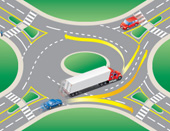
Tip
A large vehicle might have to take up both lanes within a roundabout, so leave it plenty of space to work with.
Key takeaways
- Traffic in roundabouts moves counter-clockwise and has the right-of-way over entering vehicles
- Use the left lane for turning left or going straight; right lane for turning right or going straight
- Yield to traffic on your left before entering; look for an adequate gap
- Do not change lanes inside the roundabout
- If you miss your exit, continue around -- never stop or reverse
- Signal your exit with a right-turn signal after passing the exit before yours
- Give large vehicles extra room; they may need both lanes