Module 4/Lesson 3 of 3
School Buses, Farm Equipment & Animals
What to do around school buses (including the 20-metre rule), farm equipment, horse-drawn buggies and slow-moving vehicle signs.
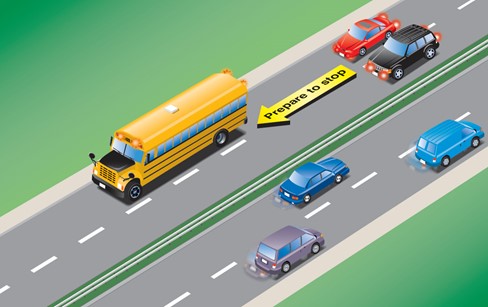
School Bus Amber Lights -- Prepare to Stop
Spot a school bus with its upper amber lights blinking and here is what it means:
- The flashing tells you the bus is about to pull over to load or unload children
- Whether you sit behind it or are heading toward it, ease off and get ready to stop
- Where a median strip divides the road, only the traffic coming up from behind the bus needs to prepare to stop

School Bus Red Lights -- You Must Stop
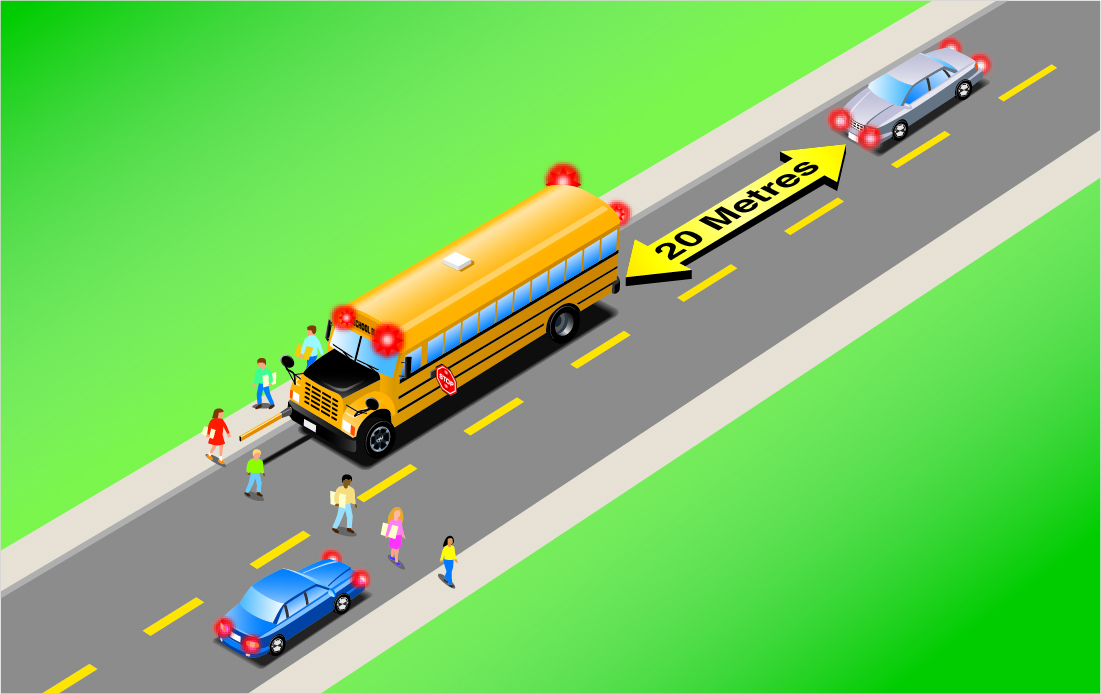
Once a school bus shows its upper red lights blinking or swings out its stop arm:
- Stopping is mandatory, no matter whether you trail the bus or are driving toward it
- On a road split by a median strip, the stop applies only to vehicles coming from behind the bus
- Coming up from behind, halt no closer than 20 metres away
- Stay put until the bus pulls away, its red lights quit flashing and the stop arm folds back in
- Rolling past anyway is both reckless and against the law

Warning
Keep at least 20 metres back from a school bus with red lights flashing. Roll through and a first offence brings steep fines plus 6 demerit points.
School Bus Penalty Details
- A first offence carries stiff fines along with 6 demerit points
- Bus drivers and any other onlookers are allowed to report drivers who pass illegally
- If you are the registered owner, the fines can land on you (though the demerit points and jail time do not)
- The school bus law binds you on every road, no matter how many lanes or what the posted speed is
- Stay ready to stop for a school bus around the clock, not merely while school is in session
- Keep an eye out for school buses near railway crossings -- every school bus is required to stop at one (and the overhead red lights are not switched on for those stops)
Farm Machinery
Next to the rest of the traffic, farm equipment crawls along:
- A typical tractor or combine tops out at 40 km/h, and drops below 40 km/h once it is hauling implements or wagons
- This machinery tends to be outsized -- wide, long, or both -- which leaves its operator struggling to see cars approaching from the rear
- Farmers frequently pull straight off into a field instead of a road or lane, or shift from one lane to another
- During the busiest planting and harvest stretches, it is routine to encounter farmers on the road after dark
Any farm machinery on the road has to carry an orange and red slow-moving sign at the back. Spot one and you should drop your speed and stay alert. Keep your distance and wait for a safe opening before passing.
Tip
That orange-and-red triangle marking a slow-moving vehicle tells you it is doing 40 km/h or less. Slow down, hang back and pass only when it is safe.
Horse-Drawn Vehicles
Among everything on the road, horse-drawn vehicles rank as some of the slowest of all. They span everything from little two-seat carts to broad, heavy farm wagons.
- For the most part they keep to the shoulder, though they may spill onto or move into the paved lane wherever the shoulder is too narrow or missing entirely -- bridge crossings being one example
- You will run into them all over southwestern Ontario, and more and more in the eastern and northern parts of the province
How to share the road with a horse-drawn vehicle:
- It must carry an orange and red slow-moving sign at the rear (and many also wear strips of highly reflective tape along the side and back)
- Ease off the gas and stay very alert
- Hold a safe following gap and only overtake when it is safe
- If one is coming the other way, hug the far-right side of your lane
- As you pass, leave it as wide a berth as you can
- Squeezing by too close can spook the horse and make it lurch unexpectedly across the road
Warning
Cutting past a horse-drawn vehicle too tightly can startle the horse into a sudden swerve. Leave it as much room as you possibly can.
Key takeaways
- Amber bus lights say get ready to stop; red lights or the stop arm mean stopping is mandatory
- Halt at least 20 metres behind a school bus showing red lights -- breaking this rule costs 6 demerit points
- Where a median divides the road, only the traffic behind the school bus has to stop
- School bus stopping rules hold on every road and around the clock, not just during school hours
- Farm machinery carries an orange-and-red slow-moving sign and travels at 40 km/h or less
- Horse-drawn vehicles turn up in parts of Ontario -- slow down and leave a wide gap when passing
- Brushing past a horse too closely can spook it into a sudden change of direction