Module 5/Lesson 5 of 5
Parking Rules & Parallel Parking
Basic parking rules, parallel parking technique, parking on hills, accessible parking and roadside stops.
Basic Parking Rules
Because the rules differ from one road and location to the next, always look out for and follow posted signs. Keep in mind that some parking by-laws are not posted on any sign.
The basics:
- Stay off the travelled portion of a road. If you have to stop, pull onto the shoulder.
- Avoid parking on a curve or hill, or anywhere your sightline falls short of 125 metres in each direction.
- Don't leave your vehicle where it would obstruct an already-parked car, or block a road entrance, pedestrian crossing, crosswalk or sidewalk.
- Keep at least 3 metres clear of a fire hydrant.
- Don't park on a bridge or within 100 metres of one.
- Where a hotel, theatre or public hall has a public entrance, stay at least 6 metres clear of it while the venue is open to the public.
- Leave 9 metres of space at an intersection, or 15 metres where traffic lights control it.
- At a level railway crossing, keep 15 metres back from its closest rail.
- Don't park anywhere you would obstruct traffic or snow removal.
Important
Key parking distances to remember: 3m from fire hydrants, 9m from intersections (15m if traffic lights), 15m from railway crossings, 100m from bridges, 125m clear view required.
Door Safety
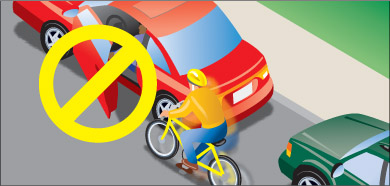
Don't pop open the door of a parked vehicle until you have confirmed you won't put any person or vehicle at risk or get in the way of traffic.
The Dutch reach method is a smart habit: use your right hand to reach across and release the driver's door, a motion that naturally prompts a shoulder check.
Be extra cautious not to swing a door into the path of cyclists, who frequently travel close to parked cars. If you have to open a door beside moving traffic, leave it open only as long as it takes to let passengers in or out.

After Parking
Once you have parked:
- Shut off the ignition and the lights
- Take the key and lock up to discourage theft
- Never leave children or animals inside the vehicle
When you set off again from a parked spot, always signal and look for traffic, easing out only once it is safe.
Accessible Parking
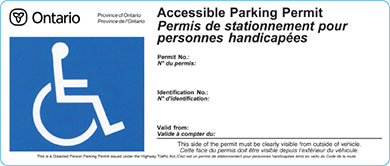
The Accessible Parking Permit is a laminated card placed on the dashboard or sun visor of whatever vehicle is carrying a person with a disability. It belongs to the person it was issued to, not to any one vehicle.
Four kinds of permit exist:
- Regular permit (blue): for permanent disabilities, good for 5 years
- Temporary permit (red): for a disability expected to last beyond 2 months yet not permanent; it cannot be renewed
- Traveller permit (purple): lasts up to 1 year and covers airport use
- Company permit (green): lasts up to 5 years, for organizations that transport people with disabilities
Don't park in a spot reserved for people with disabilities unless an Accessible Parking Permit is shown in the windshield and it belongs either to you or to one of your passengers.

Parallel Parking
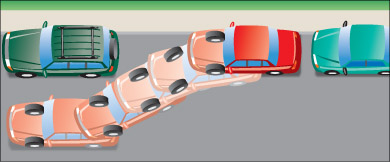
Parallel parking puts your wheels alongside and parallel to the curb. Park on the right-hand side facing the flow of traffic. One-way roads let you park on either side unless a sign says otherwise.
When parallel parking on the right, look for a gap roughly one and a half times the length of your vehicle.
The steps:
- Check traffic, signal and stop. Pull up beside the car just ahead of the open space, keeping about a metre between the two vehicles, and halt when your rear bumper lines up with theirs.
- Reverse slowly and with care while cranking the wheel all the way toward the curb.
- As soon as the outer rear corner of the car ahead comes into view, bring your wheels straight and keep backing.
- Now turn the wheel fully toward the road so your vehicle settles in line with the curb.
- Drive forward to straighten up if you are not yet parallel.
- Apply the parking brake and select park (or first/reverse on a manual). Switch off the engine, take the key, check traffic before opening the door, and lock up.

Parking on a Hill
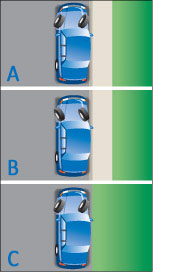
Pointed downhill: angle your front wheels toward the curb or right shoulder, so the vehicle veers off the road instead of into traffic should the brakes let go.
Pointed uphill with a curb: steer left so the wheels face the road; if the car rolls back, its tires will catch on the curb.
Pointed uphill without a curb: crank the wheels hard to the right, so any roll carries the vehicle off the road rather than into traffic.
In every case, set the parking brake and shift to park (or first/reverse on a manual), then switch off the engine and take the key.

Tip
Remember: Downhill = wheels toward curb. Uphill with curb = wheels toward road. Uphill without curb = wheels toward right shoulder.
Roadside Stop & Pulling Out
Pulling over for a roadside stop:
- Look in your mirrors and check the blind spot
- Switch on your signal (but hold off if there are vehicles waiting at side-road or driveway entrances between you and where you mean to stop)
- Steer toward the edge, slow down, and come to rest parallel to the curb, no farther than 30 centimetres from it
- Cancel the signal and put on your hazard lights
- Set the parking brake and choose the right gear
Rejoining traffic from a roadside stop:
- Let off the parking brake and shift to drive or first gear
- Cancel the hazards and switch on your left-turn signal
- Check the mirrors and blind spot for vehicles and cyclists
- Build up speed smoothly to merge with the flow
- Once you have rejoined the roadway, cancel the left-turn signal right away
Key takeaways
- Key parking distances: 3m from hydrants, 9m from intersections (15m if signalized), 15m from railway crossings
- Parking legally requires an unobstructed sightline of 125 metres each way
- Use the Dutch reach (right hand) when opening your driver door to force a shoulder check for cyclists
- Find a space 1.5 times your vehicle length for parallel parking
- Downhill parking: wheels toward curb. Uphill with curb: wheels toward road. Uphill without curb: wheels toward right shoulder
- Never park in accessible spaces without a valid Accessible Parking Permit displayed
- Never leave children or animals in a parked vehicle