Module 5/Lesson 3 of 5
U-Turns & Three-Point Turns
How and where to safely make U-turns, three-point turns and back up your vehicle.
Turning Around
Missing a turn or overshooting your destination may leave you needing to reverse your direction while driving. A few options let you do this safely:
- Circle the block -- the easiest and safest choice
- U-turn -- for when circling the block isn't an option
- Three-point turn -- best on narrow roads where a U-turn won't work
Backing Up
Go slowly and stay extra cautious whenever you reverse. Before setting off, confirm the path behind you is clear, taking special care to spot children and cyclists.
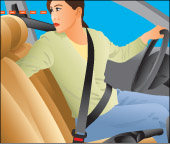
Keep a firm grip on the wheel, shift into reverse, and twist sideways in your seat so you can look over your shoulder toward where the vehicle is heading:
- Going straight back or to the right: swing your torso and head rightward, glancing back across your right shoulder
- Going to the left: swing your torso and head leftward, glancing back across your left shoulder
- Glance over the other shoulder too
- Make sure the front end clears everything when you turn during a reverse
Seatbelt exception: a seatbelt isn't required while you reverse. If unbuckling lets you twist around for a proper view, go ahead -- just fasten it again before you drive forward.

Important
Reversing is against the law on a divided road posted above 80 km/h, with the sole exception being to assist someone in trouble.
U-Turn
Ahead of any U-turn, look first to confirm that no sign forbids it.
You also need a clear view in each direction. The law prohibits a U-turn:
- On a curve in the road
- On or close to a railway crossing or hilltop
- Beside a bridge or tunnel that hides your view
Don't attempt a U-turn unless your sightline reaches at least 150 metres each way.
How to make a U-turn:
- Signal a right turn
- Check your mirror and over your shoulder
- Move to the right side of the road and stop
- Signal a left turn
- Once traffic is clear in both directions, pull forward and swing quickly and tightly into the lane opposite
- Watch for traffic throughout the turn
Three-Point Turn
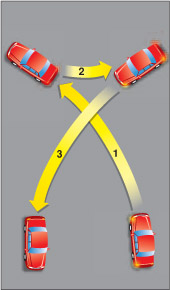
Where a road is too narrow, a three-point turn lets you reverse direction. It begins from the far-right edge of the road.
Avoid a three-point turn wherever a curve, the area at or close to a railway crossing or hilltop, or a sightline-blocking bridge or tunnel is involved.
How to make a three-point turn:
- Signal a left turn
- Once clear in both directions, drive forward while cranking the wheel hard left toward the curb on the opposite side
- On reaching the left side, stop
- Shift to reverse and signal a right turn
- Confirm the path is clear, then steer hard right as you back up slowly across to the other side
- Stop
- Select a forward gear and check for traffic
- When it is clear, drive forward

Key takeaways
- Driving around the block is the simplest and safest way to turn around
- Only attempt a U-turn when you have at least 150 metres of clear sight in each direction
- U-turns are illegal on curves, near railway crossings, hilltops, bridges or tunnels
- Three-point turns are for narrow roads where U-turns are not possible
- Always check for children and cyclists before reversing
- Unbuckling to reverse is allowed, but refasten your seatbelt before you pull forward again
- Reversing is illegal on divided roads with speed limits over 80 km/h