Module 3/Lesson 1 of 4
Steering, Signals & Hand Signals
Proper steering technique, when and how to use turn signals and hand signals.
Driving Awareness
Stay tuned in to the traffic surrounding you the whole time you drive. Build a habit of scanning forward, rearward and to each side:
- Glance at your mirrors roughly every five seconds
- Turn your head and look over your shoulder to clear your blind spots
- Adjust your speed so you don't sit in another driver's blind spot
- Stay clear of other vehicles' blind spots, especially those of large commercial vehicles, which have sizeable blind zones along their sides and rear
- Take extra care at dusk and dawn, the times of day when everyone struggles to adapt to the shifting light
Maintain a cushion of space around your car and expect the unexpected. Scan far down the road and keep an eye on anyone sitting in parked vehicles -- a door could swing open or the car could pull out.
Steer Smoothly
Every steering input should be smooth and precise:
- Aim to handle most turns and lane changes without lifting either hand off the wheel
- You need to hold a straight line even while you change gears, reach for controls or glance at your blind spot
- Imagine the wheel as a clock face and rest your hands at the nine o'clock and three o'clock marks
Tip
Keep your hands at the 9 and 3 o'clock position on the steering wheel for optimal control.
Turn Signals and Brake Lights
Your signals communicate your plans to everyone else on the road, warning them that you intend to turn or come to a stop.
Rely on your signals and brake lights to flag the move ahead of time before you:
- Stop
- Slow down
- Turn
- Change lanes
- Leave the road
- Pull out of a parked position
Flash the correct signal with plenty of lead time and confirm that others can actually see it. A signal on its own settles nothing -- always verify the path is clear first, and only then make your move once it is safe.
Important
A signal grants you no right-of-way on its own -- always confirm the path is clear before you act.
Hand and Arm Signals
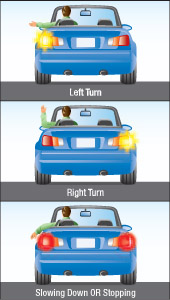
When your turn signals and brake lights have failed, fall back on hand and arm signals:
- Left turn: left arm held straight out
- Right turn: left arm out, then bent upward at a right angle
- Slowing or stopping: left arm out, then bent downward at a right angle
As you watch for signals from others, keep in mind that a cyclist may indicate a right turn by extending the right arm straight out rather than using the bent-left-arm form.

Keep Right
Stay toward the right side of the road, or use the right-hand lane where there are several, except when you plan to make a left turn or overtake another vehicle. Sticking to the right matters most when your pace is slower than the vehicles around you.
Key takeaways
- Rest your hands at the 9 and 3 o'clock marks for smooth, precise steering
- Signal with plenty of lead time before you stop, turn, switch lanes or leave the road
- A signal alone grants no right-of-way -- confirm the path is clear first
- Memorize the three hand signals: left arm straight out (left turn), bent up (right turn), bent down (stopping)
- Stay right except when turning left or overtaking another vehicle
- Scan your mirrors about every 5 seconds and keep an unbroken scanning routine going