Module 3/Lesson 3 of 4
Controlled & Uncontrolled Intersections
How to safely navigate intersections with and without traffic controls, and right-of-way rules.
Approaching Intersections
Stay sharp on the approach to any intersection, scanning for pedestrians, cyclists, other vehicles, and the yield signs, stop signs and traffic lights that govern it. Sweep your eyes across nearby sidewalks and paths or trails, not just the road surface.
Remember that children frequently don't grasp the traffic rules, and that a local bylaw may allow riding a bicycle on the sidewalk.
Intersections come in two broad types: controlled and uncontrolled.
Controlled Intersections
A controlled intersection relies on stop signs, yield signs or traffic lights to manage the flow.
Facing a green light: proceed through at a steady, careful speed. When the light has stayed green for some time, be ready for the yellow -- though if you are already too close to halt safely, continue through cautiously.
Facing a red light: come to a full stop and hold there until it turns green.
Blocked intersection: approaching on a main road and finding the intersection jammed with traffic, hold back before you enter and wait for the vehicles ahead to clear. (This rule is waived if you are turning left or right.)
Facing a yield sign: ease off, stopping if you must, and don't go through until the way opens up.
Facing a stop sign: make a full stop, then continue only once the way is clear.

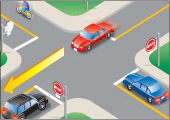
Uncontrolled Intersections
An uncontrolled intersection carries no signs and no traffic lights. You'll typically find them in quieter spots without much traffic.
Approach them with extra caution. Should two cars reach one from separate roads at the very same moment, the one on the left has to let the one on the right proceed first. That act of giving way is known as yielding the right-of-way.

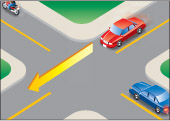
Important
At an uncontrolled intersection (no signs or lights), when two vehicles get there together, the one on the LEFT gives way to the one on the RIGHT.
Yielding the Right-of-Way
Certain scenarios force you to give way:
- Uncontrolled intersection: let any vehicle that got there ahead of you go first. Arriving together, the car on the left defers to the car on the right.
- All-way stop: the first vehicle to fully stop goes first. If two stop together, the one on the left gives way to the one on the right.
- Turning left: hold until oncoming traffic has cleared and any pedestrians in or nearing your path have crossed.
- Turning right: wait for pedestrians to finish crossing when they are in or nearing your path, and shoulder-check for cyclists coming up from behind, especially in a bike lane on your right.
- Pulling out of a driveway: when joining a road from a private lane or driveway, yield to both traffic already on the road and anyone walking on the sidewalk.
- Pedestrian crossovers: give way and let pedestrians get all the way across the road.
- School crossings: yield to pedestrians and to school crossing guards.

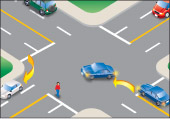
Tip
Keep in mind that flashing a signal earns you no right-of-way -- confirm the path is clear before you proceed.
Entering from a Private Road or Driveway
As you pull onto a road out of a private lane or driveway, you owe the right-of-way to:
- Traffic already travelling on the road
- People walking along the sidewalk

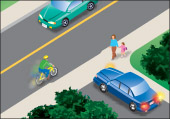
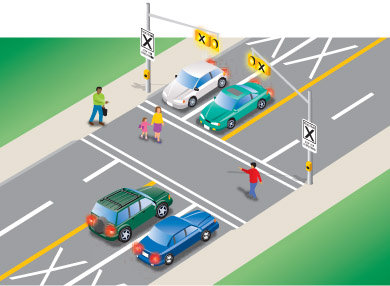
Pedestrian Crossovers
At pedestrian crossovers, and at school crossings staffed by a guard, give way and hold until everyone on foot has made it all the way across the road.
Within 30 metres of a pedestrian crossover, passing any vehicle is prohibited.

Key takeaways
- Controlled intersections use traffic lights, stop signs or yield signs
- Uncontrolled intersections carry no signs or lights -- give way to the right
- At an all-way stop, the first to stop goes first; if you stop together, left yields to right
- Turning left means yielding to oncoming traffic and to pedestrians
- Pulling out of a driveway, yield to all road traffic and to people on the sidewalk
- Let pedestrians finish crossing fully at a pedestrian crossover
- Within 30 metres of a pedestrian crossover, overtaking any vehicle is not allowed