Module 3/Lesson 2 of 4
Speed Limits & Following Distance
Ontario's speed limit rules, the 2-second following rule, and maintaining safe space.
Obey Speed Limits
Stay within the posted maximum speed limit, yet always pick a pace that leaves you able to stop safely. In practice that means easing off below the maximum whenever you face:
- Bad weather
- Heavy traffic
- Construction zones
Reduced limits are common in school zones and work zones precisely to safeguard children and the people working on or beside the road.
Important
With no limit posted, expect a 50 km/h cap inside cities, towns and villages; everywhere else the ceiling is 80 km/h.
Default Speed Limits
If no speed limit is signposted at all:
- The cap is 50 km/h inside cities, towns and villages
- The cap is 80 km/h on roads outside those built-up areas
Treat these figures as the fallback limits any time no sign sets a different number.
Cruise Control
As a driver aid, cruise control can help your fuel economy and keep you from drifting over the limit without noticing.
Even so, there are situations where you should switch it off:
- Poor road conditions (wet, icy or slippery surfaces)
- Heavy traffic
- Any time you feel fatigued
Warning
Keep cruise control off on wet, icy or slippery surfaces, in dense traffic, and whenever you are tired.
Speed Measuring Warning Devices
Ontario bans speed measuring warning devices (radar detectors). Get pulled over with one in your vehicle and you will face a fine plus demerit points.
Obey Police
Whenever an officer is directing traffic, do as they instruct -- comply even when those instructions conflict with the signs or signals.
If an officer signals you to pull over:
- Move as far to the right as is safe and come to a complete stop
- Remain inside your vehicle and wait for the officer to approach
- The moment the officer asks, hand over your driver's licence, vehicle permit (or a copy) and proof of insurance
Despite a common myth, there is no 24-hour window in which to produce these documents. Ignoring an officer's order to pull over can leave you fined, your licence suspended, or even facing jail time.
Important
Hand over your licence, permit and insurance the instant an officer asks -- no 24-hour grace period exists.
The 2-Second Following Rule
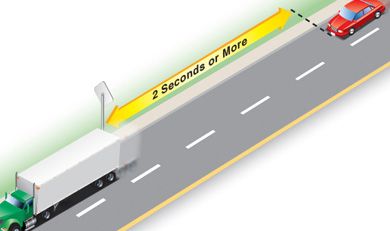
Any time you trail another vehicle, leave yourself room to brake safely should the car ahead stop abruptly. Keep a gap of at least two seconds between you and the vehicle in front.
To measure a two-second gap:
- Choose a fixed marker ahead, like a road sign or a telephone pole
- As the back of the car ahead clears that marker, start counting "one thousand and one, one thousand and two"
- Stop counting the instant your front bumper reaches the marker. Get there before you finish "one thousand and two" and you are tailgating

When You Need Extra Space
Keep in mind that two seconds is only the bare minimum gap, and it holds up just under ideal conditions. Stretch that gap out and give yourself more room when:
- The weather is bad
- You are behind a motorcycle or a large truck
- You are hauling a heavy load
Generally, match the flow of traffic around you while staying under the limit, and surround your car with a buffer to the front, rear and both sides. Never obstruct the normal, reasonable flow of traffic.
Tip
Two seconds is the FLOOR, valid only in ideal conditions. Lengthen your gap in poor weather, behind large trucks, or with a heavy load aboard.
Key takeaways
- Fallback limits: 50 km/h in urban areas, 80 km/h on rural roads when nothing is posted
- Pick a pace that always leaves you able to stop safely for the conditions
- Radar detectors are banned in Ontario -- expect fines and demerit points
- Use the 2-second rule: choose a marker and count as the car ahead clears it
- Two seconds is the minimum for ideal conditions; widen the gap in bad weather or behind big vehicles
- Follow an officer's directions even when they override the signs or signals
- Hand over your licence, permit and insurance the moment police request them