Module 3/Lesson 4 of 4
Stopping at Crossings
Rules for stopping at railway crossings, school crossings, school buses and pedestrian crossovers.
Stopping Basics
Stopping safely and well is a core skill behind the wheel. Careful, responsible drivers spot upcoming stops early, glance at their mirrors, start slowing in good time and bring the car to rest smoothly.
Braking tips:
- A proper seating position gives you better control over braking
- Work both the brake and the gas with your right foot so you never press the two together
- Apply the brake pedal steadily and with even pressure
- With a manual gearbox on a long, steep descent, drop into a lower gear -- and do that downshift before the hill, not partway down it
- A handy rule: use the same gear heading downhill that you would heading up
Where to Stop
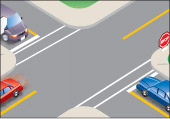
Every stop sign and red light calls for a full stop. Work down this priority list for where to halt:
- At the stop line whenever one is painted on the pavement
- With no stop line, at the crosswalk, whether or not it is marked
- With no crosswalk, at the edge of the sidewalk
- With no sidewalk, at the edge of the intersection
Hold there until the way opens up before you move into the intersection.

Railway Crossings
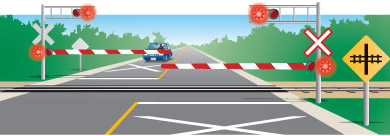
On Ontario's public roads, every railway crossing carries a large red and white "X" sign. Alongside it you might find:
- Yellow advance warning signs
- Big "X" markings painted on the pavement ahead of the tracks
- Flashing signal lights at certain crossings
- Gates or barriers at certain crossings
- Stop signs at some of the quieter crossings
Bear in mind that a train under full emergency braking can need as much as two kilometres to come to a halt.
A crossing on a private road might carry no markings at all -- so stay watchful.

Railway Crossing Rules
As you reach a railway crossing:
- Ease off, listen, and check both directions before you cross
- With a train approaching, halt no closer than 5 metres to the nearest rail or gate
- Don't try to beat a train to the crossing
- Hold until the signal lights have gone dark and any gates or barriers sit fully up before crossing
- Never steer around, under or through a gate or barrier that is down, dropping or rising -- doing so is both against the law and dangerous
- Don't come to rest on top of the tracks (in heavy traffic, confirm there is space to clear them entirely first)
- Hold off on changing gears while you're on the tracks
- If you find yourself stuck on a crossing: get everyone out and well clear of the car at once, reach a safe spot, and then alert the authorities
- At unprotected railway crossings, most buses and other public vehicles are obliged to stop
- Every school bus must stop at all railway crossings, whether or not gates or signals are present
- Where a railway crossing carries a stop sign, stopping is mandatory unless a flagman waves you on
Warning
With a train approaching, halt no closer than 5 metres to the nearest rail or gate. NEVER steer around, under or through a railway gate that is down, dropping or rising.
School Crossings
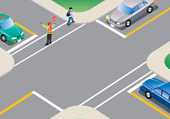
When a school-crossing guard holds up a red and white stop sign, you are required to:
- Come to a stop before you reach the crossing
- Stay stopped until everyone, the guard included, has stepped clear of the whole roadway and it is safe to go
- Whenever you're unsure, wait until every child and the guard are off the crossing
Ignoring these rules can cost a driver a hefty fine along with 3 demerit points.

Important
Not stopping for a school crossing guard brings a hefty fine plus 3 demerit points.
Stopping for School Buses
Ontario's school buses are painted chrome yellow, carry the words "School Bus," and are built in several sizes.
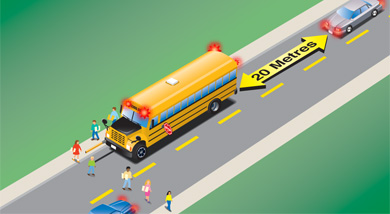
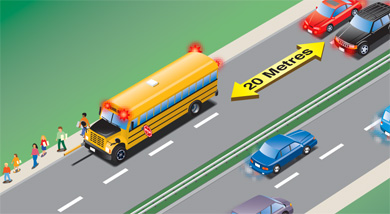
Once a school bus has its upper alternating red lights flashing:
- A stop is mandatory, whether you sit behind the bus or are coming toward it from the front
- Coming from the front, halt far enough back to give children room to cross
- Coming from behind, leave at least 20 metres of gap
- Stay put until the bus pulls away or its lights go off
Median strip rule: on a road split by a median strip -- a solid barrier dividing the two directions of traffic -- only the vehicles coming up from behind the bus are obliged to stop.
Stop arm: a school bus also extends a stop-sign arm on its driver's side once those red lights start flashing. Keep stopped until that arm tucks back in and every light goes dark.

School Bus Penalties
Failing to stop for a halted school bus whose red lights are flashing is breaking the law.
What it can cost you:
- A steep fine together with 6 demerit points on a first offence
- Across Ontario, bus drivers and other witnesses are able to report anyone who illegally passes a school bus
- If you are the registered owner, the fines may land on you (though the demerit points and any jail time will not)
The school bus law applies on every road, regardless of lane count or posted speed. Stay ready to stop for one at any hour, not only during the school day.

Warning
Passing a stopped school bus illegally brings steep fines plus 6 demerit points, and bus drivers or other witnesses can report the offending vehicle.
Pedestrian Crossovers
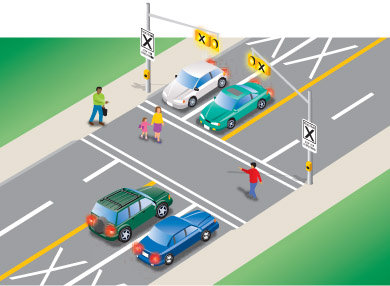
A pedestrian crossover is a marked spot set up so people on foot can cross safely where no traffic lights exist. Keep an eye out for pedestrians and for anyone using a wheelchair.
- A pedestrian can press a button that sets the overhead yellow lights flashing as a warning
- They should point or otherwise signal their intent before they step off the curb
- Both drivers and cyclists have to give way to pedestrians using the crossover
- Don't move on until the pedestrians and any school crossing guards have finished crossing and are back on the sidewalk safely
- Inside the 30-metre zone ahead of a pedestrian crossover, overtaking any vehicle is forbidden

Key takeaways
- Halt at the stop line first, then the crosswalk, then the sidewalk edge, then the intersection edge
- At a railway crossing, hold at least 5 metres back from the nearest rail when a train is coming
- Never steer around railway gates that are down, dropping or rising
- Stop for school crossing guards and wait until everyone is clear of the roadway (3 demerit points if you don't)
- Leave at least 20 metres behind a school bus flashing its red lights (6 demerit points if you don't)
- Where a median divides the road, only vehicles trailing the school bus need to stop
- Within 30 metres of a pedestrian crossover, overtaking any vehicle is prohibited
- School bus rules apply on every road at any hour -- not just school hours