Module 12/Lesson 1 of 3
G2 Road Test Guide
Comprehensive guide to all driving tasks evaluated during the Level Two (G2) road test, including turns, intersections, freeway driving, lane changes, parking, and three-point turns.
Overview of the Level Two Road Test
Across every age group, drivers who are new to the road get into serious or deadly crashes at much higher rates than seasoned ones. To encourage safer habits early on, the province rolled out graduated licensing in 1994.
Working through this two-stage program takes a minimum of 20 months and involves two separate road tests. Once you clear the Level Two (G2) road test, you earn full Class G driving privileges.
The Level One test checks fundamental driving skills, whereas the G2 test focuses on the more advanced knowledge and skills that usually come with time behind the wheel. Throughout the test, the examiner gives you instructions and confirms that you carry out each required action correctly.
Expressway driving component:
- You must complete, then put your signature on, a "Declaration of Highway Driving Experience"
- On the form you report how often, during the three months leading up to the test, you drove on a freeway and/or a highway posted at 80 km/h or more
- You also state your typical trip distance (under 5 km, 5-15 km, or over 15 km)
- Qualifying freeways are: 400, 401, 402, 403, 404, 405, 406, 407, 409, 410, 416, 417, 420, 427, QEW, Don Valley Parkway, Gardiner Expressway, E.C. Row Expressway, and Conestoga Parkway
- Lacking enough experience, the examiner must rule the test "out-of-order" and cancel it, costing you 50% of your prepaid road-test fee
Important
You MUST have highway driving experience to take the G2 road test. Without it, the test will be cancelled and you lose 50% of your fee.
Current G Road Test Elements
For now, the G road test leaves out the manoeuvres that the G2 test has already assessed:
- Parallel parking
- Roadside stops
- 3-point turn
- Driving in residential neighbourhoods
What the G test continues to cover:
- Travelling on major roads and expressways (merging, speed, spacing, signalling)
- Turns, curves, and lane changes
- Intersections
- Driving in business areas
Left and Right Turns
The Approach (from the examiner's instruction up to the point just before the intersection):
- Traffic check: Scan all around before easing off the gas. Use the rearview and side mirrors. Shoulder-check your blind spots if you plan to change lanes.
- Lane: As soon as it is clear, move over into whichever outermost lane (far left or far right) matches your turn
- Signal: Switch on your signal before braking, but where vehicles are waiting to pull out from side streets or driveways sitting between your car and the intersection, hold off signalling until you have gone past them
- Speed: Bring your speed down gradually. With a manual transmission you can downshift while slowing; never coast with your foot resting on the clutch
- Space: Stay at least 2-3 seconds back from the vehicle ahead
If Stopped:
- Stop completely, with no forward or backward roll
- Leave yourself enough room behind the car ahead to pull out and pass without reversing
- Halt behind the stop line if one is painted; otherwise the crosswalk, then the sidewalk edge, then the edge of the intersection
- Hold your front wheels straight while waiting to turn left, so a rear-end hit cannot shove you into oncoming traffic
- Turning right at a large intersection, angle in tight to the curb so no other vehicle can squeeze between you and it
Making the Turn:
- Recheck traffic by glancing left, ahead, then right just before you enter. Shoulder-check your blind spots if another vehicle might pass you mid-turn
- Keep both hands on the wheel for the entire turn
- Avoid shifting gears mid-turn in a manual
- Once it is safe, begin moving within 4-5 seconds
- Steer into the matching lane without crossing any lane lines or curbs
Completing the Turn:
- Finish in the lane that lines up with the one you started from
- Turning left onto a road with several lanes: build back to normal speed first, then ease over to the curb lane when it is clear
- Glance at your mirrors and accelerate smoothly back up to the flow of traffic

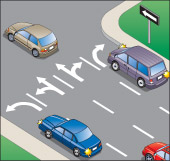
Stop Intersection
The Approach:
- Scan in every direction, using your mirrors, before you begin braking
- Ease off speed gradually and hold a 2-3 second gap behind the car ahead
The Stop:
- Stop fully with no creeping. Stop behind the stop line, or failing that the crosswalk, sidewalk edge, or intersection edge
- Keep enough room to steer around the vehicle ahead if it stalls
- Once you are past the stop line, never reverse
Driving Through:
- Keep watching traffic the whole time you wait. Glance left, ahead, then right before pulling in
- When right-of-way is unclear, catch the eye of nearby drivers or pedestrians
- Hold both hands on the wheel as you cross
- Don't change gears partway through (manual transmission)
- Set off within 4-5 seconds once clear, accelerating smoothly up to traffic speed

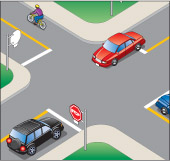
Through Intersection (Uncontrolled)
The Approach:
- Glance both ways for any traffic on the road that crosses yours
- Should you have to slow, check your mirrors for vehicles behind
- Hold your speed steady unless something might cross ahead of you; if so, slow down or cover the brake with your foot
- Stay alert for pedestrians and for vehicles nosing into the intersection
- Maintain a 2-3 second following gap
Driving Through:
- Stay within your lane lines and avoid switching lanes inside the intersection
- If your path is blocked, slow or stop rather than swinging around the obstruction
- Keep both hands on the wheel
- Don't change gears as you cross
- Glance at your mirrors before building back up to normal speed

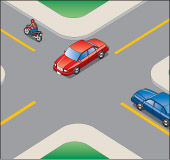
Freeway: Entering
On the entrance ramp:
- The instant freeway traffic coming up behind becomes visible, scan your mirrors and blind spot for a gap to slide into
- Keep an eye on any vehicles ahead of you on the ramp and hold back a safe margin
- Keep splitting your focus between what's in front, your mirrors, and your blind spot
- Flip on your signal once drivers already on the freeway can see you
- Stay 2-3 seconds behind the car ahead, and pick your moment so you don't end up alongside another vehicle or in its blind spot
- Take the ramp's curve slowly enough that people and objects inside aren't thrown around
- Use the acceleration lane to bring your speed up to match the freeway flow
- Blend in with one smooth, gradual move toward the middle of the closest freeway lane
- Switch off the signal once you've merged

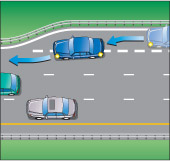
Tip
In the acceleration lane, match freeway traffic speed BEFORE merging. Do not try to merge at a significantly lower speed.
Freeway: Driving Along
- Watch the traffic around you and glance at your mirrors every 5-10 seconds
- Don't go over the limit or crawl along unreasonably slowly; aim for a steady pace
- Scan ahead to where you'll be in the next 12-15 seconds for hazards or obstacles
- Stay at least 2-3 seconds back from the car ahead
- When someone is tailgating you, open up extra room ahead or move to another lane
- Try to leave a buffer on either side and stay clear of other drivers' blind spots
- Don't sit behind large vehicles that hide your view of the road
Freeway: Exiting
- Ahead of moving into the exit lane, glance both ways and check your mirrors and blind spots
- Put your signal on before you reach the exit lane
- Move into the exit lane right at its start with one smooth, gradual movement, staying within the lane lines
- Hold your speed until you are fully inside the exit lane
- Once you're in it, slow down little by little so traffic doesn't bunch up behind you
- Take the exit ramp's curve at a sensible speed
- With a manual transmission, downshift as your speed drops
- Keep a 2-3 second following gap
- Turn the signal off once you're on the exit ramp
Important
Do NOT slow down while still in the freeway travel lanes. Wait until you are completely in the exit lane before reducing speed.
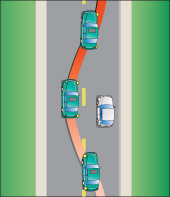
Lane Change
- While you wait for a safe opening, scan all around, splitting your attention between the front, your mirrors, and your blind spot
- Look at the lane on the far side of the one you're entering, in case another driver is heading into it at the same time
- Signal once there's enough room, then shoulder-check your blind spot one more time before you start moving over
- Keep 2-3 seconds behind the vehicle ahead and avoid ending up beside or inside someone else's blind spot
- Match your speed to the traffic already in the new lane
- Cross over with a single smooth, gradual movement into the middle of the new lane
- Keep both hands on the wheel
- Turn off the signal once the change is done

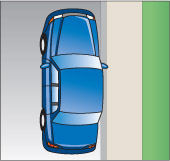
Roadside Stop
The Approach:
- Glance at your mirrors and look for signs to confirm stopping is allowed here
- Scan for vehicles coming up from both the front and the rear; a 150-metre gap in each direction gives you enough room to do this safely
- Shoulder-check your right blind spot if traffic or pedestrians might pass you on that side
- Signal before braking, unless side roads or driveways sit between you and your stopping point
- Bring your speed down gradually
- Pull up parallel to the curb, no more than roughly 30 centimetres from it. Where there's no curb, get as far off the road as you can
The Stop:
- Cancel the signal and switch on your hazard lights
- Automatic: shift to park and set the parking brake. Manual: set the parking brake and put it in neutral (engine running) or in low/reverse (engine off)
- On a slope, turn the wheels toward the curb in the direction that keeps you from rolling
Resume:
- Start the engine, release the parking brake, and pick the right gear
- Switch off the hazards and put on your left signal
- Check your mirrors and your left blind spot right before you pull out
- Accelerate smoothly to blend with traffic
- Turn off the signal once you're back on the road

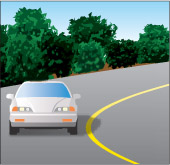
Driving on a Curve
- Work out a safe speed from the available clues: posted signs, how sharp the bend looks, and the kind of road you're on
- Be down to that safe speed by the point you're 30 metres into the curve
- On a blind curve, ease off more in case oncoming traffic strays into your lane or the bend turns out tighter than it looked
- Brake BEFORE you reach the curve so you aren't braking inside it
- Hold a steady, suitably slow speed all the way through
- As you near the exit, start accelerating back to normal speed
- Don't change gears within the curve (manual transmission)
- Look across the bend, as far around it as you can, to keep yourself centred in the lane

Tip
Always reduce speed BEFORE entering a curve, not during it. Look as far around the curve as possible to maintain smooth steering.
Business Section
- Look both ways everywhere vehicles or pedestrians could enter the road: business entrances, institutions, construction sites, pedestrian crossings, and railway crossings
- Glance at your mirrors every 5-10 seconds, and more frequently when traffic is heavy
- Travel in the safest through-traffic lane (typically the curb lane, switching to the centre lane if the curb lane is blocked)
- Keep yourself centred in the lane and scan 12-15 seconds ahead
- Stay 2-3 seconds back from the car ahead, and add distance if you're being tailgated
- On roads with several lanes, keep a buffer on both sides and stay out of others' blind spots
- Stopping behind another vehicle, keep enough room to see its rear tires or to pull around it without reversing
Residential Section
- Stay alert for driveways, sidewalks, schools, pedestrian crossings, and anything else that could be a hazard
- Out on rural roads, watch the entrances to homes, farms, businesses, and industrial sites
- Glance at your mirrors every 5-10 seconds
- Hold the centre of your lane; with no lane markings, centre yourself on the travelled portion of the road
- Where a curve or hill blocks your view ahead, ease right so an oncoming vehicle over the centre line can't hit you
- Scan 12-15 seconds ahead
- Keep a 2-3 second following gap
Parallel Park
The Approach:
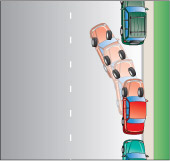
- Check your mirrors, then shoulder-check your blind spot before moving into position
- Signal before you start braking
- Pull up beside (parallel to) the parked car that sits ahead of the open space
- Keep a gap of 60 centimetres or more from the parked car alongside you
- Stop once you are fully alongside, level with the empty space
Parking:
- Before reversing, look all around and check your mirrors and both blind spots
- Hold off until the path is clear
- Start backing up while steering toward the curb
- About halfway into the space, straighten the wheel to line up with the curb
- Edge forward or back as needed to sit within the markings and leave room for the cars around you
- Avoid striking the curb or touching another vehicle
- Put it in park (automatic) or set the parking brake and shift to low/reverse (manual)
- On a slope, turn your wheels in the direction that prevents rolling
Resume:
- Start the engine, release the parking brake, and choose the right gear
- Signal, then check your mirrors and blind spot
- Accelerate smoothly, switching off the signal once you've pulled away

Tip
When parallel parking, leave a gap of at least 60 cm from the parked car beside you, and take care not to scrape the curb or make contact with another vehicle.
Three-Point Turn
The Approach:
- Check traffic ahead and behind, and shoulder-check your blind spot if needed
- Signal before braking
- Pull up parallel to the curb, no more than 30 centimetres away
Turn Around:
- Check your mirrors and blind spot just before you begin
- Wait for a clear path, then signal left
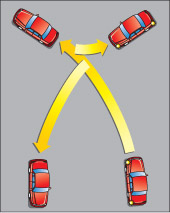
- Crank the wheel hard left and ease slowly across the road
- Once you reach the far left side, stop and shift into reverse
- Crank the wheel hard right and back up until the vehicle points the new way
- Stop and put it back in a forward gear
- Make use of the entire road for the turn, and reverse just once
- Don't back over the road's edge or shoulder, or into the curb
Resume:
- Check your mirrors before building up speed
- Accelerate smoothly to blend with traffic

Key takeaways
- The G2 road test requires a Declaration of Highway Driving Experience -- without enough experience, the test is cancelled
- Scan your mirrors and blind spots before every change in speed or direction
- Keep both hands on the wheel as you turn through intersections
- Once it's safe, set off within 4-5 seconds -- but don't rush
- Hold a following gap of at least 2-3 seconds at all times
- On a freeway, reach traffic speed in the acceleration lane before you merge
- Hold your speed until you are completely inside the freeway exit lane
- Brake before a curve begins, not while you're in it
- Parallel parking: leave 60 cm from the parked car, and avoid hitting the curb or touching other vehicles
- Three-point turn: use the entire road, reverse only once, and stay off the road's edge
- While waiting to turn left, keep your wheels straight so a rear-end hit can't push you into oncoming traffic