Module 11/Lesson 3 of 3
Towing Trailers
Licence requirements, trailer registration, brakes, lights, hitches, loading, and safe driving techniques when towing.
Towing a Trailer: Overview
Before you hitch up a trailer, weigh your vehicle's size, power, and condition. It has to be up to the job of pulling both the trailer and whatever you load into it, and your trailer and hitch have to meet every requirement.
Towing safety facts:
- When a recreational vehicle is being towed, close to half of the reported crashes turn out to be single-vehicle ones
- A further 20% are rear-end collisions
- Where the driver was at fault, roughly 30% had "lost control" of the vehicle
Licence and Permit
Where the gross vehicle weight comes to 4,600 kilograms or less, the trailer can be towed on any valid driver's licence of Class G1, G2, or G -- or a higher class.
Should your trailer and its load go beyond the size and weight limits set in the Highway Traffic Act, you might be required to hold a higher class of licence or carry an oversize vehicle permit.
Behind a non-commercial vehicle, towing more than a single trailer is against the law.
Important
A trailer up to 4,600 kg requires at least a G1 licence. Towing more than one trailer behind a non-commercial vehicle is against the law.
Registering Your Trailer
The law treats a trailer as its own vehicle. To tow it on a public road, you first have to:
- Register it, paying a one-time fee at a ServiceOntario centre
- Receive your licence plate and vehicle permit
- Mount the plate on the rear of the trailer so it is plainly visible
- Keep your permit, or a copy of it, with you to show an officer on request
Trailer Safety Condition
A trailer has to be safe to operate. If it falls short, a police officer can pull it off the road until it has been made safe again.
Trailer Brakes
Where the gross trailer weight -- trailer plus load -- reaches 1,360 kilograms or more, the trailer needs brakes powerful enough to bring it to a stop and hold it there.
Important
A trailer of 1,360 kg or more (including its load) is required to have its own brakes.
Trailer Lights
Every trailer needs to carry:
- A white light over the licence plate
- Two red reflectors at the back, spaced as far apart as they can be
- A red tail light
Once its width passes 2.05 metres, a trailer also requires:
- Two yellow clearance lights up front, one per side and as far apart as possible, signalling the width to drivers approaching you
- Two red clearance lights or reflectors at the back, one per side and as far apart as possible, signalling the width to drivers behind you
On top of that:
- A trailer needs mud guards, fenders, and flaps, unless its design already keeps it from spraying or splashing the traffic behind
- When the load hides your view to the rear, you must fit extra mirrors that give you a clear look behind
Attaching Your Trailer
Your trailer needs two independent connection methods to the vehicle, so that the trailer stays linked even if one of them fails or works loose.
Safety chains:
- Run them crossed beneath the tongue, which keeps the tongue from hitting the pavement if the main hitch lets go
- The hooks on the chains must use latches or other devices that cannot come undone on their own
Tip
Cross the safety chains UNDER the trailer tongue. That way, if the hitch lets go, the tongue does not drop onto the road.
No Passengers in Trailers
While a trailer is under tow, no one is allowed to ride inside it -- and that holds for house and boat trailers alike.
Warning
Carrying passengers inside any trailer under tow is against the law -- house trailers and boat trailers included.
Trailer Hitch
Choose a well-made trailer hitch. Which class you need comes down to the gross weight of the trailer (the trailer together with its load).
- Match the hitch class to how heavy your trailer is
- Fasten the hitch firmly to the vehicle, in line with the manufacturer's instructions
- Set the hitch-ball so that, once the trailer is hooked up and tightened, it sits level with no tilt
- If the rear of your vehicle gets dragged down, switch to a load-equalizing trailer hitch or move some of the load toward the back of the trailer
- Beyond the ball and hitch, fit safety chains or cables rated to hold the trailer and its load
Loading Your Trailer
As you load up, tie everything down, both inside the trailer and on the outside. Having a load that could shift loose or drop off is an offence. Avoid overloading as well -- excess weight strains the vehicle and can wreck your tires, wheel bearings, and axle.
Getting the weight distribution right matters:
- For proper hitch weight, keep more of the load ahead of the trailer axle than behind it
- Of the trailer's total weight, aim for about 5 to 10 per cent to bear down on the hitch, staying within the limit stamped on it
- A badly balanced load can set the trailer swaying or fishtailing
- Loading too heavily at the back can pop the ball and hitch apart
What heavy or badly placed loads can do:
- Drag down the rear of the vehicle and lift the front
- Compromise your steering, particularly on wet, slippery surfaces
- Throw off your headlight aim, so the low beams dazzle oncoming drivers
- Knock your mirrors out of alignment
Hauling a boat on a trailer: leave the boat empty unless the trailer is built to handle the added weight.

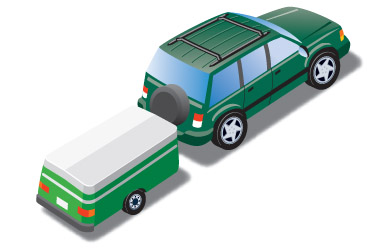
Important
Keep 5-10% of the trailer's total weight on the hitch. Loading more of it ahead of the axle helps stop sway and fishtailing.
Starting Out and Pre-Trip Checks
Run through this list ahead of every trip:
- The trailer hitch
- Wheels and tires
- Lights
- How the load is distributed and whether it is secure
- Tire pressure -- with the trailer loaded and the tires still cold
As you pull away, build up speed gently and keep your driving slow and careful.
Driving Techniques: Curves and Turns
Curves: Hold a line near the centre of your lane.
Right turns:
- Scan the traffic and glance in your right mirror
- Signal, then ease off your speed
- For a tight turn, pull forward until your front wheels sit well past the curb before you swing right
Left turns:
- Scan the traffic and signal
- Move through slowly
- Take a wide arc, driving well into the intersection before you turn
Driving Techniques: Slowing, Stopping, and Passing
Slowing down and stopping:
- Stopping abruptly can make the trailer jackknife or skid sideways, or send the load shifting
- Leave a bigger gap between you and the vehicle in front
- Stay clear of the fast lanes
- Hold a speed that lets you ease off and stop smoothly in any situation
Passing:
- Towing means you cannot pick up speed as fast
- The extra length of your rig calls for more room
- Confirm you have ample time and space to finish the pass
- Give yourself extra distance before returning to your lane -- do not pull back in too early, or the trailer will start to sway
Being passed:
- If a line of vehicles is stacking up behind you, signal, ease onto the shoulder, and wave them by
- Fast trucks and buses throw off a powerful blast of air; the "wall of wind" trailing them can whip your trailer sideways
- Should that happen, resist braking -- steer carefully back on line, and a small bump in speed can help
Backing Up a Trailer
- Reverse at a crawl and station a helper outside to guide you
- Steer with a string of small adjustments
- Backing toward the right: turn the wheel LEFT (the front swings left, the rear swings right)
- Backing toward the left: turn the wheel RIGHT (the front swings right, the rear swings left)
Practise it somewhere safe -- an empty parking lot, away from traffic -- until it feels natural.
Tip
Reversing a trailer means steering the OPPOSITE way from where you want the rear to head. Rehearse it in an empty lot first.
Towing Disabled Vehicles
When your vehicle breaks down, the safest move is to call a professional tow truck that is built for the job. If you have no choice but to use another vehicle:
- Switch on warning signals or emergency flashers
- Fasten the two vehicles together securely
- Have someone ride in the broken-down vehicle and work the brakes to keep the tow cable taut
- Skip the tow entirely if the engine cannot run on a vehicle with power brakes and steering -- with no engine, both become hard to manage, and the tow can end in a crash
Attempting to bump-start a dead vehicle by towing it is risky and can harm both vehicles.
Warning
Do not tow a disabled vehicle that has power brakes or steering when its engine will not run. Without the engine, steering and braking become extremely hard.
Key takeaways
- Towing a trailer up to 4,600 kg gross weight requires at least a G1 licence
- The law counts a trailer as its own vehicle, so it must be registered and plated
- A trailer of 1,360 kg or more, including its load, needs brakes of its own
- A trailer measuring over 2.05 metres in width needs clearance lights both front and rear
- Two independent connection methods are required, and the safety chains cross beneath the tongue
- Nobody may ride inside a trailer while it is under tow
- Keep 5-10% of the total trailer weight on the hitch, and more of the load ahead of the axle to curb sway
- Carrying a load that could shift loose or fall off is an offence
- To reverse, turn the wheel the opposite way from where you want the trailer's rear to go
- Stopping abruptly can trigger jackknifing -- leave a bigger following gap when towing
- Never attempt to bump-start a dead vehicle by towing it -- it is risky and can harm both vehicles