Module 12/Lesson 2 of 3
Off-Road Vehicles & Snowmobiles
Licensing, registration, safety requirements, where you can drive, hand signals, and impaired driving rules for snowmobiles and off-road vehicles.
Introduction
Many Ontarians enjoy snowmobiles and off-road vehicles for recreation, yet these machines are not toys. Before you ride one, you need to understand how it operates, how to handle it safely, and which Ontario laws govern it.
These vehicles are built for off-road terrain. You cannot ride dirt bikes on public roads. Snowmobiles are permitted on certain public roads in restricted ways. Among off-road vehicles, only single-rider all-terrain vehicles (ATVs) are allowed on the shoulder of certain provincial highways and on municipal roads, and only where local bylaws allow it.
Important: Whether your vehicle is a car, a motorcycle, a snowmobile, or an off-road vehicle, alcohol poses a serious threat to safety.
Snowmobile: Licensing Requirements
Who can drive a snowmobile:
- Anyone holding a valid Ontario driver's licence of any class
- Without a driver's licence, if you are 12 years or older a valid Motorized Snow-Vehicle Operator's Licence (MSVOL) lets you ride on trails that recreational organizations set up and maintain
- Riding a snowmobile along or over any public road calls for a minimum age of 16, plus either a driver's licence or an MSVOL (not both)
MSVOL: The Ontario Federation of Snowmobile Clubs (OFSC) issues it, working with the Ministry of Transportation. Getting one means passing a snowmobile driver-training course, which runs roughly 6 hours spread over 3 days.
Visitors to Ontario need a valid licence from their home province, state, or country that permits them to operate a snowmobile.
Carry your licence any time you ride a snowmobile somewhere other than your own property, and show it on request to a police or conservation officer.
Should your licence be suspended, you cannot drive any kind of vehicle on or off any road, or anywhere public.
Snowmobile: Registration and Insurance
Registration:
- Your snowmobile needs to be registered through a ServiceOntario centre under the Ministry of Transportation
- A newly bought snowmobile must be registered within 6 days of sale
- The registration fee is one-time; in return you get a permit and a registration number decal
- Stick the decal on both sides of the cowling or engine cover, positioned so the number begins 10-15 cm from the rear of the cowling
- At all times, carry your driver's licence or MSVOL along with proof of registration
Validation sticker: A validation sticker must sit on the registration decal unless you are riding on your own property or you qualify as an exempt northern Ontario resident; renewal carries an annual fee.
Insurance: Riding your snowmobile off your own property requires liability insurance. Keep the insurance card on you and present it on request. If you let another person ride your snowmobile, the two of you share responsibility for any penalties, damages, or injuries.
Snowmobile: Safety Equipment
Helmet: A helmet is mandatory any time you ride a snowmobile or any toboggan or sled it tows. It isn't legally required on your own land, though wearing one there is still wise. The helmet has to meet the approved standards for motorcycle or motor-assisted bicycle helmets and be done up snugly under the chin.
Face protection: Wear a face shield or goggles at all times to guard against windburn, frostbite, sunblindness, and watering eyes. Pick lightly tinted, shatterproof eyewear:
- Clear plastic on dull, overcast days
- Deep yellow in late afternoon, when flat light masks dips in the snow
- Steer clear of dark tints, which cut down what you can see
Snowmobile: Pre-Trip Checks
Run through these before each outing:
- Steering mechanism -- swing the handlebars side to side to confirm the turning is smooth and unrestricted
- Motor drive belt -- inspect its condition and tension
- Emergency switch, headlights, and tail lights
- Battery solution level
- Throttle and brake levers -- confirm they move freely
- Spark plugs and the fuel level (don't use matches or a lighter while checking, and never refuel with the motor running)
Towing a toboggan or sled: Hook it up with a rigid tow bar and a safety chain. Anything towed needs reflective material on the front sides, rear sides, and rear. On public roads, towing is usually banned except when crossing at a 90-degree angle.
Snowmobile: Where You Can and Cannot Drive
You MAY drive on:
- Your own property
- The private trails of organizations you are a member of
- Private property where the owner has given permission
- Public parks and conservation areas that allow it
A snowmobile can only use a public highway to cross it directly. Under certain conditions, riding is allowed along the non-serviced stretch of some highways. Local municipalities are free to enact bylaws that govern snowmobile use.
You MAY NOT drive on:
- Certain high-speed roads, freeways, the QEW, the Ottawa Queensway, or the Kitchener-Waterloo Expressway -- including the whole area from fence line to fence line
- The serviced part of a road (shoulder to shoulder), except to cross it
- Railway tracks, unless the railway authority has granted permission
When crossing a road:
- Slow down, come to a stop, then cross at a 90-degree angle
- Riding in a group, never wave the rider behind you across -- each rider should judge the traffic on their own
- Only if visibility is poor may you then signal that the way is clear
Snowmobile: Speed Limits and Safety Tips
Speed limits:
- 20 km/h inside any public park or exhibition ground, and on any road where the limit for other traffic is 50 km/h or under
- 50 km/h on snowmobile trails, and on any road where the limit for other traffic tops 50 km/h
- Municipalities are allowed to set different limits
Safety tips:
- Keep plenty of extra room between yourself and the snowmobile in front
- Slow down after dark and don't outrun your headlights
- Wear gear with reflective markings so you stand out at night
- Map out your route ahead of time and make sure everyone in your group knows it too
- If you have to stop on the trail, pick a spot where you'll be seen and pull off to the right
- When a group stops, line the machines up single file and leave them running so they show up at night
- On hard-packed snow or ice, cut your speed -- stopping and turning both take longer
- Stuck in deep snow? Shut off the motor before you try to dig the snowmobile out
- Crossing ice, look out for pressure cracks, which are tougher to spot after dark
- Think about a buoyant snowmobile suit when riding over frozen lakes or rivers
Warning
Heading out onto ice always puts your safety on the line. Ask local authorities about current ice conditions, and if you have no choice but to cross, a buoyant snowmobile suit is worth wearing.
Snowmobile: Hand Signals
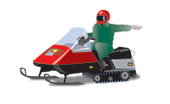
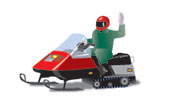
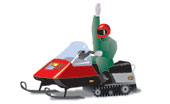
Hand signals let you tell other snowmobilers what you're about to do before you stop, slow down, or turn. Make the signal clearly and in plenty of time.
- Left turn: Hold your left arm straight out, pointing the way you intend to turn
- Right turn: Lift your left arm to shoulder level, bending it at the elbow
- Stop: Reach your right arm straight up above your head, palm open and flat
- Slowing: Stretch your left arm out and downward along your side, flapping it up and down
- Oncoming snowmobiles: With your left arm raised to shoulder height and the elbow bent, sweep it left to right above your head, pointing toward the right edge of the trail
- Snowmobiles following: Raise your bent left arm to shoulder height and swing it front to back over your shoulder, like a hitchhiker's thumb
- Last snowmobile in line: Keeping the elbow bent, lift your left forearm to shoulder height and make a fist



Snowmobile: Wind-Chill Factor
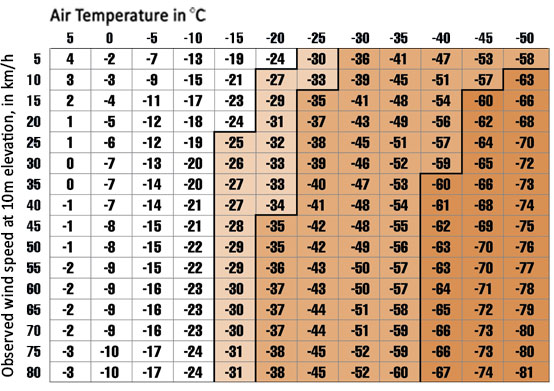
Wind-chill is what you get when wind and cold temperatures work together: a breezy winter day feels far colder than the thermometer reads because moving air carries heat away faster. As an example, an actual reading of -10 degrees C paired with a 40 km/h wind feels like -31 degrees C.
Approximate thresholds:
- At or below -25 degrees C: prolonged exposure brings a risk of frostbite
- At or below -35 degrees C: frostbite can occur within 10 minutes
- At or below -60 degrees C: frostbite can occur in under 2 minutes
Layer up with a waterproof outer shell over several inner layers. Keep your hands and face covered and pull on a balaclava. Staying out in the cold too long can bring on hypothermia.
Off-Road Vehicles: Licensing and Registration
Examples of off-road vehicles (ORVs) are ATVs, two-up ATVs, side-by-side ATVs, utility terrain vehicles (UTVs), amphibious ATVs, off-road motorcycles, and dune buggies.
Note: Go-peds (electric and motorized scooters) and pocket bikes don't count as off-road vehicles, so they can't be registered as such.
Age requirements:
- You must be 12 or older to operate an ORV, unless you're on land the vehicle owner occupies or you're under close adult supervision
- You must be 16 or older to register one
- Riding it on or over any public road calls for a minimum age of 16 plus a valid Ontario driver's licence of Class G2, M2, or higher
Registration:
- Register at a ServiceOntario centre within 6 days of taking ownership
- In return you get a vehicle permit and a licence plate
- Two or three wheels: mount the plate on the front
- Four or more wheels: mount the plate on the rear
- Keep the vehicle permit on you whenever you ride, except on the owner's property
Insurance: You need it any time you ride off the vehicle owner's property. Keep the insurance card with you. When another person rides your vehicle with your permission, the two of you share responsibility.
Off-Road Vehicles: Where You Can and Cannot Drive
Across most of Ontario's public roads, riding an ORV is prohibited -- and that ban covers medians, shoulders, and ditches too.
Exceptions:
- Crossing straight over certain public roads
- Some ORVs with 3 or more wheels travelling along certain public roads to do farm work, to hunt with a licence, or to trap fur-bearing animals (the vehicle has to weigh 450 kg or less and stay within 1.35 m of width)
- Inside a provincial or public park where the park authority allows it
- Emergency personnel carrying out their duties
All-Terrain Vehicles (ATVs):
An ATV is defined by a few features: four wheels all touching the ground, handlebars for steering, and a seat the driver straddles.
On the designated shoulders of provincial highways, an ATV has to:
- Weigh 450 kg or less
- Stay within 1.35 m of overall width, mirrors not counted
- Satisfy the federal Motor Vehicle Safety Act and the ANSI standard
- Be built for just the driver, carrying no passengers
- Move in the same direction as the traffic on that side of the road
- Hug the right of the shoulder or road edge as closely as is safe
When a road falls under a municipality's authority, that municipality has to pass a bylaw before ATVs are permitted on it. With no such bylaw, the road is off-limits to ATVs.
ATV rules on permitted roads:
- Hold a valid Ontario licence (G2, M2, or higher)
- Wear a motorcycle helmet with the chin strap done up securely
- Carry no passengers
- Speed limits: where the posted limit is 50 km/h or less, ride at 20 km/h or less; where it is over 50 km/h, ride at 50 km/h or less
ATVs are banned from controlled-access highways, including the 400-series and most of the Trans-Canada.
Important
ATV speed limits sit BELOW the posted limits: a 20 km/h cap where the posting is 50 or under, and a 50 km/h cap where the posting is above 50.
Off-Road Vehicles: Safety Equipment and Rules
Helmet: A motorcycle helmet that meets HTA standards is required any time you ride an ORV or anything it tows -- the lone exception being the vehicle owner's property.
Body protection: Always put on:
- A face shield or goggles
- Long pants that cover your legs
- A long-sleeved shirt or jacket
- Gloves
- Boots tall enough to reach above your ankles
- Brightly coloured clothing so others can see you
Don't carry passengers on a one-person vehicle; doing so shifts the weight balance and reduces how well you can control it.
Pre-trip checks:
- The brake control moves freely
- The throttle opens and closes smoothly in every steering position
- Tires are in good shape and properly inflated
- No leaks in the fuel lines
- Fuel and oil levels are adequate
- The engine idles smoothly (start it in neutral)
- The lights all work
Collision reporting: On public highways, tell police right away about any crash that injures someone or causes damage over $2,000. The snowmobile threshold is $400.
Careless and dangerous driving offences cover every ORV driver, and all HTA offences apply as well once you're on a public road.
Impaired Driving Rules (Snowmobiles and ORVs)
Operating a snowmobile or an ORV while impaired by alcohol or drugs breaks the law. The BAC thresholds and penalties match those that govern cars:
- BAC above .08: a Criminal Code offence carrying an immediate 90-day ADLS
- The .05 to .08 "warn range": a 3-day suspension for a first instance, 7 days plus education for a second, and 30 days plus treatment and an ignition interlock for a third or later
- Drivers 21 or younger on a full-class licence: their BAC has to be zero; getting caught means a 24-hour roadside suspension, and a conviction adds a fine plus a 30-day suspension
- Every novice driver (G1, G2, M1, M2): BAC must be zero, with escalating penalties (30 days for the first, 90 days for the second, and cancellation of the licence on a third within 5 years)
- A novice driver also faces Criminal Code charges should their BAC go past .08
📌 Handbook vs. current law: For the zero-tolerance rule above, the official MTO Driver's Handbook -- and therefore the G1 test -- still cites the 24-hour roadside suspension, so that's the answer to give on the exam. In practice, Ontario law has since swapped it for an escalating immediate roadside suspension of 7 days (first), 14 days (second), and 30 days (third) within a five-year window, together with a $250-$450 administrative penalty. (The novice escalating penalties -- 30 days / 90 days / cancellation on conviction -- have not changed.)
Police may pull over any driver to check for alcohol or drugs. Turning down any demand -- breath, blood, oral fluid, urine, a physical coordination test, or a drug evaluation -- brings Criminal Code charges plus a 90-day ADLS.
Warning
Alcohol plays a major role in snowmobile deaths. The impaired-driving laws written for cars apply equally to snowmobiles and off-road vehicles.
Snowmobiler's Code of Ethics
- Act as a responsible sportsperson and conservationist, and use your example to steer fellow riders toward responsible conduct
- Leave no litter on trails or at camping spots, and keep lakes and streams free of pollution
- Leave living trees, shrubs, and other natural features undamaged
- Honour the property and rights of other people
- Stop to help anyone you find in distress
- Offer yourself and your snowmobile for search-and-rescue work
- Don't get in the way of hikers, skiers, snowshoers, or people ice fishing
- Learn and follow every federal, provincial, and local rule
- Leave wildlife in peace and stay out of any area posted to protect it
- Never ride where snowmobiles are banned
Key takeaways
- Driving a snowmobile takes a driver's licence of any class or an MSVOL; riding on or across public roads requires being 16 or older
- Register and insure your snowmobile, registering it within 6 days of buying it
- A properly fastened motorcycle-standard helmet is required on both snowmobiles and ORVs
- Snowmobile speed limits: 20 km/h in parks and zones limited to 50 km/h; 50 km/h on trails and faster roads
- A snowmobile may cross a public road only at a 90-degree angle, and only after stopping
- ORV riders must be at least 12; riding on public roads requires being 16 or older with a G2/M2 or higher licence
- ATVs on permitted roads: cap of 20 km/h where the posting is 50 or under, and 50 km/h where it's above 50
- ATVs and single-rider ORVs carry no passengers
- The impaired-driving laws for regular vehicles apply just the same to snowmobiles and ORVs
- Report a snowmobile crash to police when damage tops $400, and an ORV crash on a highway when it tops $2,000
- If your snowmobile gets stuck in snow, shut the motor off before working it loose