Module 4/Lesson 1 of 3
Pedestrians & Cyclists
How to share the road safely with people walking and cycling, covering bike lanes, the passing gap you must leave and practical safety habits.
Overview
You will share Ontario's roads with all kinds of traffic -- people on foot, motorcyclists, cyclists, transport trucks, buses and farm equipment. Stay alert to who else is using the road, how fast each of them moves and how much room they take up.
Sharing the Road with Pedestrians
Keeping the road safe is a duty that falls on both walkers and motorists. Before they step onto the roadway, pedestrians have to confirm that a driver has spotted them and has either stopped or is clearly coming to a halt. Drivers, for their part, must operate their vehicles carefully and react appropriately whenever someone is on foot nearby. Usually that comes down to one thing: giving the pedestrian the right of way.
Important
Making eye contact with a pedestrian -- and having them lock eyes with you -- is one of the surest ways to keep them safe.
Watch for Children
Keep your speed low and stay alert anywhere kids might be walking or at play -- school zones, residential areas and similar spots.
Never assume a child understands the rules of the road, so expect the unexpected:
- A youngster could suddenly dash out from between parked vehicles
- A child may step into the street without first looking for traffic
- Take special care at twilight, when children may still be outside playing yet are hard to spot
Crosswalks and Crossings
Look out for every crosswalk. A crosswalk may be any stretch of road that:
- Joins the sidewalks on either side into one unbroken walking path
- Carries signs, painted lines or other markings set up for people to cross
Do not overtake a vehicle that has stopped at a crosswalk. When a car ahead has halted, take it as a hint that someone is walking across.
Mind school crossings and crossing guards. At pedestrian crossovers, school crossings and any spot staffed by a crossing guard, everyone -- drivers and cyclists alike -- has to halt and surrender the entire road. You may only carry on once every pedestrian and the crossing guard have reached the sidewalk safely.
Notice community safety zones. These signs flag stretches the local community has singled out as posing a heightened danger to people on foot.
Warning
Many crosswalks have no markings at all, yet you will find one at almost every intersection. Never drive past a vehicle that has come to a stop at a crosswalk.
Special Pedestrian Situations
Slower walkers -- Stay patient and give everyone enough time to finish crossing. Older adults and people with disabilities deserve added care and courtesy.
People with visual disabilities -- They may rely on a white cane or a guide dog to move safely down sidewalks and through intersections.
Quiet vehicles -- If you drive a hybrid or electric vehicle, remember that those with limited sight frequently listen for an engine before stepping into an intersection. Since your vehicle barely makes a sound while braking or idling, you need to be especially careful.
Wheelchairs and medical scooters -- Anyone using a motorized wheelchair or a medical scooter counts as a pedestrian as well.
Streetcar stops -- Certain stops include a dedicated safety island or zone. Roll past them at a sensible speed and stay ready for sudden movements.
Distracted pedestrians -- Walkers absorbed in their phones, ear buds or headphones often tune out car horns and the surrounding traffic.
Dark clothing -- Someone dressed in dark colours is tough to make out, particularly after dark. The combination of failing light and dark clothing is a frequent trigger for collisions.
New transport devices -- Motorized skateboards, scooters and roller blades can be hard to control and may send their riders veering into the road.
During turns -- A great many pedestrians are struck by vehicles turning left, because the driver and the walker are each focused elsewhere -- the driver on working through the intersection, the walker on the path straight ahead.
Sharing the Road with Cyclists
When bicycles and mopeds move more slowly than the surrounding traffic, the expectation is that they keep roughly one metre out from the curb or any parked cars, or hug the right edge of the road as closely as is practical. That said, for their own safety they are allowed to occupy any portion of the lane when they need to, for instance to:
- Steer clear of hazards (puddles, ice, sand, debris, potholes, sewer grates)
- Take railway or streetcar tracks at a 90-degree angle
- Discourage drivers from squeezing past when a lane is too tight to share safely
A cyclist is under no obligation to stay near the right edge when they are:
- Moving at, or quicker than, the prevailing pace of traffic
- Making a left turn or lining up for one (they are free to use a left-turn lane)
One-Metre Passing Rule
As you overtake a cyclist, you are required -- where it is practical -- to leave a gap of at least one metre between your vehicle and the rider.
Ignore that requirement and you risk a fine plus an extra 2 demerit points.
Wherever you can, switch lanes to get around them. And avoid riding close on a cyclist's tail: bicycles have no brake lights, so they cannot signal you when they are about to slow down or stop.

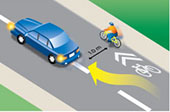
Important
Always leave a gap of 1 metre or more as you pass a cyclist. Skip that buffer and you face a fine plus 2 demerit points.
Cyclists at Intersections
Keep these habits to steer clear of crashes with cyclists at intersections:
- Turning right: Signal, then look in your mirrors and over your right shoulder into the blind spot so you do not clip a cyclist
- Turning left: Hold your position and let approaching bicycles clear the intersection before you go
- Going straight through: Look carefully for any cyclist who is positioned to turn left
Resist leaning on your horn as you pass a cyclist for no good reason -- a sudden blast can startle them into losing control. If a horn really is warranted, give it a light, quick tap while you are still well back from them.
Bike Lanes, Bike Boxes & Sharrows
Bike lanes are set aside for cyclists and are usually marked off with a solid white line. At times you will have to move into or across one to turn right at a corner or into a driveway. Only enter the bike lane once you have confirmed it is safe to do so, and then complete your turn.
Keep in mind that a bike lane can run right beside a row of parking bays.

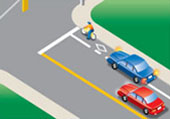
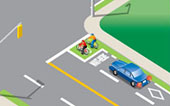
Bike Boxes
Bike boxes are designed to cut down on crashes between cars and bicycles at intersections. Picture a box painted onto the pavement with a white bicycle emblem in the middle; the bike lanes feeding into and out of it are sometimes painted as well.
Behind the wheel, you have to wait for the traffic signal behind the bike box. Never stop inside the box itself.

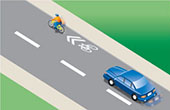
Sharrows
A sharrow -- a pair of chevrons painted over a bicycle emblem on the pavement -- signals that the lane is shared. Both cars and bikes may be travelling in it, so the marking is essentially an extra reminder to keep an eye out for cyclists using the lane.

Children on Bicycles & Door Safety
Kids pedalling along the street often have not yet learned the skills that safe cycling demands, and they may not grasp every hazard or every rule of the road. Be especially watchful for a child on a bicycle that is too big for them to handle.
Learn to read a cyclist's hand signals -- for example, a rider stretching out their right arm is letting you know they intend to turn right.
Opening doors safely: Before you swing a door open while parked at the roadside, glance behind you and scan your mirrors and blind spots in case a cyclist is coming by.
Motorcycles & Limited-Speed Motorcycles
Because of how small they are, motorcycles, limited-speed motorcycles, mopeds and bicycles can be tough to notice. Riders may swerve without warning to deal with rough pavement or rough weather, and with so little protecting them they stand a far greater chance of being hurt in a crash.
- A motorcycle is entitled to a whole lane -- give it the same respect you give any car
- Plenty of motorcycle signals stay on rather than cancelling on their own. So when you are turning left across the path of an oncoming motorcycle whose signal is blinking, double-check that the rider truly means to turn -- they might simply have left the signal running
Key takeaways
- Give pedestrians the right of way in nearly every situation, and rely on eye contact to keep them safe
- Assume kids do not know the rules of the road; ease off the gas in school zones and neighbourhoods
- Never overtake a vehicle that has stopped at a crosswalk
- Leave a gap of 1 metre or more when passing a cyclist -- breaking the rule costs a fine and 2 demerit points
- At intersections, hold behind a bike box instead of stopping inside it
- Scan your mirrors and right blind spot for cyclists before turning right
- Before opening a door while parked, look back for any passing cyclist
- Give motorcycles a full lane, and stay skeptical of signals that may not have switched off