Module 4/Lesson 2 of 3
Large Vehicles, Buses & Streetcars
Staying safe in traffic alongside tractor-trailers, commercial trucks, city buses and streetcars.
Why This Matters
Knowing how to handle yourself around big commercial rigs like tractor-trailers and buses really matters. According to recent figures, when someone dies in a crash with one of these large trucks, the cause is usually not something the truck operator did but rather the fault of the other driver.
That is why you have to stay mindful at all times of what a large vehicle can and cannot do.
Warning
In most deadly crashes involving big trucks, the blame lies with the OTHER driver rather than the trucker. Grasping the limits of large vehicles could save your life.
1. Blind Spots
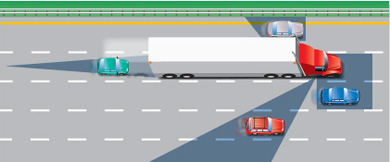
A large commercial vehicle carries sizeable blind spots down each side.
- Steer clear of tailgating one -- sit directly behind it and the driver has no way of seeing you
- Should it brake abruptly, you will be left with nowhere to escape
- A handy test: if the driver's face is not visible to you in their side mirror, then you are invisible to them too

2. Stopping Distance
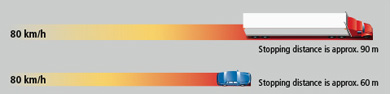
It takes a big commercial vehicle far more road to come to a halt than it takes a small car.
- After overtaking one, don't slip back in front of it too tightly
- Doing so is risky, since it eats into the buffer of space the large vehicle relies on to brake safely
- Give yourself extra room whenever you pass one

3. Wide Turns
To turn right without clipping the curb, a large vehicle often has to veer left first before swinging around.
- When one is turning right, resist the urge to pull forward into the gap that opens in the right lane
- As soon as its front end rounds the corner, the back of the vehicle swings back over into the right lane
- Sit in that lane and you will find your car trapped between the trailer and the curb
- Hang back until the truck has fully exited the lane
You will face the same hazard where an expressway off-ramp offers a pair of left-turn lanes -- never slide into the left one while a large vehicle is turning left there.
Warning
Never slide into the gap alongside a large vehicle that is turning. You could end up pinned between its trailer and the curb.
4. Rolling Back
Whenever you are stopped behind a large vehicle, keep a generous cushion between you. As its driver eases off the brakes from a standstill, the vehicle can drift backward.
5. Spray
When the weather turns nasty, a large vehicle can kick up heavy sheets of mud, snow and debris that splatter your windshield and briefly rob you of your view.
6. Turbulence
Air pressure and the rush of airflow around a large vehicle can stir up strong gusts of turbulence. That wind can make it harder to keep your own car steady as you go by.
Municipal Buses and Bus Bays
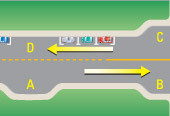
On a lot of city streets you will find recessed pull-in spots set aside for buses to load and unload riders -- these are called bus bays. They come in three forms:
- Recessed bays in the middle of a block
- Cut-outs placed right before or right after intersections
- Stops carved out between two stretches of designated parking
Key rule: If a bus sitting in a bay switches on its left-turn signal to show it is about to pull out, and you happen to be coming up in the lane right beside the bay, you are required to let the bus merge back into traffic.

Important
When a city bus signals left to pull out of a bus bay, you are obligated to let it back into traffic.
Streetcars
Unless the street runs one way, you are required to overtake a streetcar on its right side.
Where a streetcar has halted to let people board or get off, keep a buffer of no less than 2 metres back from its rear doors. That requirement is waived at stops equipped with a safety island for streetcar riders. Either way, ease past these spots at a sensible speed.
Important
Keep at least 2 metres back from the rear doors of a halted streetcar while riders are getting on or off.
Key takeaways
- When a big-truck crash turns deadly, the other driver -- not the trucker -- is usually to blame
- Can't spot the trucker's face in their mirror? Then they can't spot you either
- Big vehicles take far longer to stop, so never tuck back in front of one too tightly
- Don't slide into the gap beside a turning large vehicle; wait for it to clear the lane entirely
- A stopped large vehicle can drift backward -- keep extra space behind it
- Let a city bus merge back into traffic once it signals left to leave a bus bay
- Hold a buffer of at least 2 metres behind a stopped streetcar's rear doors