Module 2/Lesson 5 of 6
Seatbelts & Child Safety
Ontario's seatbelt laws, proper use, child car seats, booster seats and age/weight requirements.
Seatbelt Laws
Wearing a seatbelt correctly can be the difference between life and death. Even a modest rise in how many people buckle up translates into many lives saved.
Any time you ride in a vehicle fitted with seatbelts, you must wear yours. Every passenger has to be secured as well, whether by their own booster seat, child car seat or seatbelt.

Important
Seatbelts are required for everyone in the vehicle. A driver can face fines and demerit points for going unbelted, or for not making sure passengers under 16 are buckled properly.
Penalties for Not Wearing a Seatbelt
- A driver who fails to buckle up can be fined and handed 2 demerit points
- Fines and demerit points can also follow if a driver doesn't make sure every passenger under 16 is properly secured
- G1 drivers: the only person allowed in the front seat is the accompanying driver, and a seatbelt must be there for them
- Novice drivers: a seatbelt is required for each passenger
- Should a driver not have a working seatbelt available for each passenger, the result can be losing their licence for 30 days or more
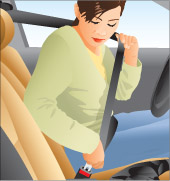
Wearing Your Seatbelt Properly
- A seatbelt should fit snugly enough to hold you in your seat through a collision
- Never share one seatbelt between two people -- doing so can lead to serious injury or death
- Run the shoulder strap across your shoulder, never tucked beneath your arm or behind your back
- Position the lap belt low across the hips, not up against the stomach
- Buckle up every time, even in a seat with an active airbag
- An airbag is no substitute for a seatbelt -- in a crash, the belt holds you in place so that the airbag can do its job
Warning
Keep the shoulder strap off your arm and out from behind your back. The lap belt rides low across the hips, never across the stomach.
Why Seatbelts Save Lives
- A seatbelt holds you inside the vehicle and helps you stay in control during a crash. Anyone thrown clear of a vehicle is far less likely to survive.
- It also stops your head and body from striking the vehicle's interior or another occupant. Go beltless and the steering wheel, windshield, dashboard or a fellow passenger may be what halts you -- this "human collision" frequently causes serious injury.
- Fires and submersion in water are uncommon in crashes. When they do occur, a seatbelt helps you stay conscious, giving you a chance to escape.
- The safest spot for a passenger is inside the vehicle and properly buckled in. Riding in a towed trailer, or in the open bed of a pickup truck, is unsafe.
Child Car Seats -- Overview
Keeping children safe means securing them correctly -- in a booster seat, seatbelt or child car seat -- with the choice driven by their age, weight and/or height.
Studies have found that a child car seat used the right way can lower the odds of death or injury by 75 per cent.
Making sure each passenger under 16 is properly buckled falls to you as the driver. Any child car seat must satisfy Canadian Motor Vehicle Safety Standards.

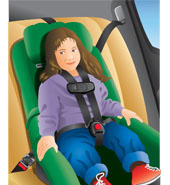
Rear-Facing Child Car Seats (Under 9 kg / 20 lbs)
An infant weighing less than 9 kilograms (20 lbs) has to ride in a rear-facing child car seat that's anchored to the vehicle with a seatbelt or a UAS (Universal Anchorage System) strap.
- The back seat is always the best place to install a rear-facing child car seat
- Never position a rear-facing child car seat where there's an active airbag -- a deploying airbag could seriously injure the child
Warning
NEVER place a rear-facing child car seat in front of an active airbag. This is extremely dangerous.
Forward-Facing Child Car Seats (9-18 kg / 20-40 lbs)
A toddler in the 9 to 18 kilograms (20 to 40 lbs) range must ride in a child car seat held to the vehicle by a seatbelt or UAS strap, and the seat's tether strap also has to be clipped to the vehicle's tether anchor.
A child heavier than 9 kg (20 lbs) may stay in a rear-facing car seat as long as it is built to fit that child's height and weight. Follow the manufacturer's instructions in every case.
Booster Seats (18-36 kg / 40-80 lbs)
Compared with a seatbelt on its own, a booster seat offers 60 per cent more protection. A child needs one when they:
- Have grown too big for their forward-facing child car seat
- Are younger than 8 years old
- Weigh 18 kg (40 lbs) or more but under 36 kg (80 lbs)
- Stand shorter than 145 cm (4 feet, 9 inches)
A booster lifts the child up so the adult seatbelt fits and works better:
- The top of the booster, the vehicle seat or a headrest has to support the child's head
- A booster seat must be paired with a lap/shoulder belt
- The shoulder belt should hug the body, passing over the shoulder and crossing the centre of the chest
- The lap belt should rest firmly against the body, across the hips
- If your vehicle is fitted with lap belts only, restrain the child with the lap belt alone. Never combine a lap belt by itself with a booster seat
Important
A booster seat adds 60% more protection over a seatbelt alone. It's required for children under 8 who weigh 18-36 kg and stand shorter than 145 cm.
When Can a Child Use a Regular Seatbelt?
A child can move to a seatbelt once they're able to wear it correctly (the lap portion lying flat over the hips, and the shoulder portion crossing the middle of the chest and resting over the shoulder) AND at least one of these is true:
- The child reaches 8 years of age
- The child weighs 36 kg (80 lbs) or more
- The child measures 145 cm (4 feet 9 inches) or taller
Don't seat a child in front of an airbag unless that airbag is switched off. For a child under 13, the back seat is the safest place to ride.
Securing Child Car Seats Properly
Installing a child car seat correctly is essential:
- As you fit it, drive one knee into the seat and lean your weight on it to press it into the vehicle seat, then cinch the seatbelt or UAS strap as tight as you can
- Once installed, the car seat should shift no more than 2.5 cm (1 inch) at the point the seatbelt or UAS strap passes through it
- Where it's needed, fit a locking clip so the seatbelt stays locked in place (check your vehicle owner's manual)
- A rear-facing seat should sit at the correct 45-degree angle -- prop up the base with a towel or pool noodle if it doesn't
- For a forward-facing seat, 80 per cent of its base should be firmly backed by the vehicle seat
- Always tie down loose objects with cargo nets or straps, or stow them in the trunk
Your local public health unit or a car seat clinic, staffed by certified technicians, can help you fit the seat.
Tip
After installation, a child car seat should shift by 2.5 cm (1 inch) at most, measured where the seatbelt or UAS strap threads through it.
Buying a Used Child Car Seat
Take care when purchasing a second-hand child car seat. Confirm that it:
- Includes the full set of manufacturer's instructions along with every necessary part
- Shows no signs of wear or damage
- Has never been through a collision
- Carries no recall
- Still falls within the useful life expectancy set by the manufacturer
Key takeaways
- Everyone in the vehicle must wear a seatbelt -- fines and demerit points apply otherwise
- The driver must make sure every passenger under 16 is properly restrained
- Used correctly, a child car seat cuts the risk of injury or death by 75%
- Rear-facing seats: for infants under 9 kg (20 lbs) -- never set in front of an active airbag
- Forward-facing seats: for toddlers 9-18 kg (20-40 lbs), with the tether strap clipped in
- Booster seats: for children under 8 who weigh 18-36 kg and stand shorter than 145 cm
- A child can switch to a regular seatbelt at age 8, 36 kg, or 145 cm -- whichever comes first
- For a child under 13, the back seat is the safest place to ride