Module 2/Lesson 4 of 6
Mirrors, Blind Spots & Clear View
How to adjust mirrors, find and minimize blind spots, and maintain clear visibility.
Keep a Clear View
Maintain an unobstructed view whenever you drive:
- Keep anything that would block your view out of your windows
- No coating may be applied to your windows if it stops you from seeing out in any direction
- Likewise, the windshield and front door windows can't be coated in a way that prevents anyone from seeing into the vehicle
Warning
Window coatings are illegal if they obstruct your view in any direction or keep others from seeing in through the windshield or front door windows.
Find Your Blind Spots
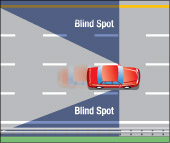
Inspect and set your mirrors, then locate your blind spots -- the zones on either side of your vehicle that your view can't reach. Pedestrians or cyclists sitting in those zones may go unseen. In some vehicles the blind spot is large enough to swallow a whole car without you noticing.
For most vehicles, the blind spots fall to the back left and back right.

How to Adjust Your Mirrors
Set your mirrors to leave you with the fewest blind spots you can manage:
- Interior (rearview) mirror: Aim it so the middle of the mirror frames the middle of the rear window -- you should then have a clear view straight out the back.
- Left outside mirror: Lean toward the window and adjust the mirror until the side of your car is just barely in view.
- Right outside mirror: Lean toward the middle of the vehicle and adjust until, once again, the side of your car only just appears.
Keep what each mirror shows from overlapping. Your side mirrors only cover narrow angles, so the lone way to confirm nothing is hiding in a blind spot is to turn your head and do a shoulder check.
Tip
Want to map out the size and location of your blind spots? Have a friend walk a circle around your car while you track them in the mirrors.
Shoulder Checks Are Essential
Because side mirrors capture only narrow angles, some blind spots will remain no matter how carefully you set the mirrors. The only reliable check is to turn your head and look over your shoulder before you change lanes, merge or turn -- that's how you confirm a blind spot is clear.
Get to know your own vehicle's blind spots. To learn their size and location, ask someone to walk around your car as you follow them in the mirrors.
Key takeaways
- On most vehicles the blind spots sit to the back left and back right
- Aim the interior mirror so it frames the centre of the rear window
- Set each side mirror by leaning toward it until the side of your car just appears
- Keep your mirrors from overlapping so they cover as much as possible
- A shoulder check -- turning your head -- is the only dependable way to clear a blind spot
- Windows can't be blocked or coated in any way that obstructs your view