Module 2/Lesson 3 of 6
Know Your Vehicle & Get Into Position
Familiarizing yourself with vehicle controls, instruments and proper seating position.
Know Your Vehicle
Familiarize yourself with your vehicle before you take it out. Today's vehicles come in many varieties, each with its own features, such as:
- Anti-lock brakes
- Four-wheel drive
- Fuel ignition systems
- Traction control and stability control systems
- Technologies that help with steering, braking and/or accelerating (lane keeping, collision avoidance, adaptive cruise control)
Consult the vehicle owner's manual so you understand how each of these systems functions, how to use them correctly, and where their limits lie.

Important
Whatever technologies your vehicle offers, stay attentive, be prepared to take the controls yourself, and remember that responsibility for every part of driving still rests with you.
Learn Your Controls
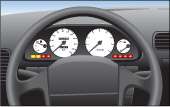
Be certain you know where every control and instrument sits and what each one does:
- Confirm that all warning lights and gauges are working
- Be alert to a warning light that remains lit after you pull away -- it may point to a serious problem
- Practise operating the key controls without glancing away from the road: headlights and high beams, heater and defroster, wipers and washers
Being able to work these essential controls by feel is an important part of driving.
Get Into Position
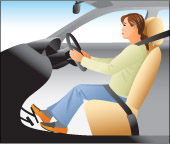
Take care to settle into the right position behind the wheel:
- Sit high enough that you can see over both the steering wheel and the hood
- Your view should reach the ground 4 metres ahead of the vehicle (a firm cushion helps if you fall short)
- Keep your back straight and upright, with your elbows slightly bent
- Slide the seat until your feet comfortably reach the pedals
- A quick check: set your feet flat on the floor beneath the brake pedal -- if you manage that without stretching, your position is right
This holds you in the correct upright posture and gives you steadier control while manoeuvring.

Headrest & Driving Space
When your vehicle comes with an adjustable headrest, set it to the correct height. For protection in a crash, the back of your head should line up directly with the middle of the headrest.
Make sure the front seat gives you enough space to drive properly and safely. Don't let passengers or belongings crowd your driving area.
Tip
Set your headrest so the back of your head sits directly in front of its centre. That positioning guards against whiplash in a crash.
Key takeaways
- Learn your vehicle's controls so you can work the wipers, headlights, heater and defroster by feel
- Today's driver-assist technologies don't lift your responsibility as the driver
- Sit high enough to see the ground 4 metres ahead, keeping your elbows slightly bent
- Set the headrest so the back of your head lines up with its centre
- A warning light that stays lit after you start out may signal a serious problem