Module 9/Lesson 3 of 3
Pavement Markings
Yellow and white line meanings, stop lines, crosswalks, turn arrows, and pedestrian crossovers.
Purpose of Pavement Markings
Working alongside road signs and traffic lights, pavement markings tell you which way traffic flows and where you are and are not allowed to go. Their jobs include separating lanes, identifying turning lanes, marking out pedestrian crossings, flagging obstacles, and signalling when passing is unsafe.
Key colour rule:
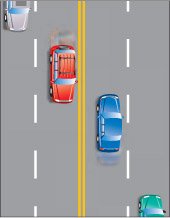
- Yellow lines divide traffic that is heading in opposite directions
- White lines divide traffic that is moving in the same direction

Tip
Remember: YELLOW = opposite directions; WHITE = same direction. This is one of the most commonly tested pavement marking rules.
Solid vs. Broken Lines
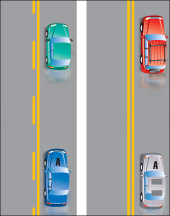
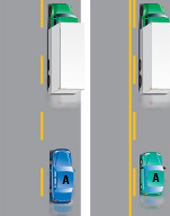
A solid line on the left edge of your lane: passing is not safe here, so hold your position in the lane.
A broken line on the left edge of your lane: you are allowed to pass provided the road ahead is clear and enough broken line remains for you to finish the manoeuvre safely.
Where a solid line and a broken line run together, look at whichever line sits on your side of the road. A solid line on your side means no passing; a broken line on your side means you may pass when it is safe.


Continuity Lines
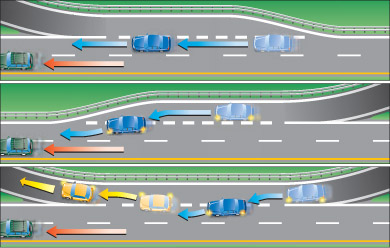
Continuity lines are broken lines drawn thicker and spaced more tightly than the usual broken markings.
- Spotting them to your left usually signals that your lane is about to end or peel off, so you will need to merge over to keep going the way you are headed
- Spotting them to your right means your lane simply carries on unchanged

Stop Lines
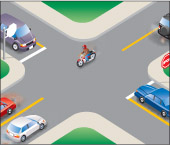
Painted across the roadway at an intersection, a stop line is a lone white stripe that marks the spot where you have to halt.
When no stop line is painted:
- Halt at the crosswalk, whether or not it is marked
- With no crosswalk present, halt at the near edge of the sidewalk
- With no sidewalk either, halt at the near edge of the intersection

Crosswalks
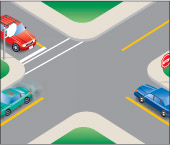
A crosswalk shows up as a pair of parallel white lines running across the roadway, though at intersections one is not guaranteed to be painted.
Stopping rules:
- With no stop line present, halt at the crosswalk
- With no crosswalk, halt at the near edge of the sidewalk
- With no sidewalk, halt at the near edge of the intersection

Directional Arrows
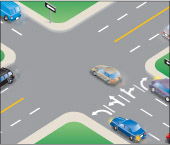
Where a white arrow is painted within a lane, you are restricted to travelling the way that arrow points. Intersections use them to mark out turn-only lanes and through lanes.

Pedestrian Crossovers
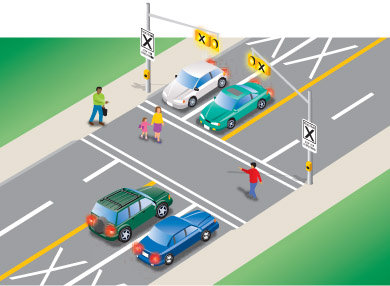
You can recognize a pedestrian crossover by its dedicated signs, the yellow lights overhead, and the markings on the road. On the pavement it appears as two sets of double white parallel lines spanning the road, with an X painted in each lane on the approach.
Both drivers and cyclists are required to stop ahead of the line and let pedestrians go, holding until every pedestrian has finished crossing and is fully off the roadway.

Important
At a pedestrian crossover, remain stopped until the person is ENTIRELY off the road, not merely past your own lane.
Obstacle Markings
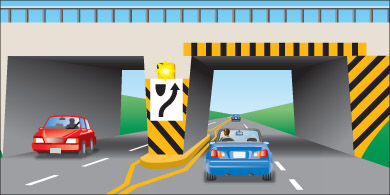
A pair of solid lines on the road surface steers traffic clear of stationary hazards like concrete islands or bridge piers. The hazards themselves are also given yellow-and-black markings to serve as a warning.

Key takeaways
- Yellow lines separate opposing traffic; white lines separate same-direction traffic
- Solid line on your side = no passing; broken line on your side = passing permitted when safe
- Continuity lines (wider, closer together) on your left mean your lane is ending or exiting
- Stop at the stop line, then crosswalk, then sidewalk edge, then intersection edge (in that priority order)
- Crosswalks exist at intersections even when not marked -- you must stop for them
- White arrows on pavement indicate the mandatory direction for that lane
- At pedestrian crossovers (marked with X in each lane), stop and wait until pedestrians completely clear the road
- Solid pavement lines near fixed objects steer traffic clear of obstacles such as bridge piers