Module 9/Lesson 2 of 3
Pedestrian Signals
Walk and don't-walk signals, crossing rules for pedestrians, and intersection pedestrian signals with push buttons.
Pedestrian Walk and Don't Walk Signals
At intersections equipped with traffic lights, pedestrian signals exist to guide people across safely.
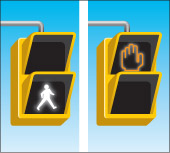
White walking symbol (Walk signal):
- Someone facing this symbol is clear to cross in the direction the signal points
- For the whole crossing, a pedestrian outranks every vehicle and holds the right-of-way
Flashing or steady orange hand symbol (Don't Walk signal):
- Anyone facing the orange hand should NOT step off the curb to start a crossing
- A person who is partway across when the hand lights up should move promptly to a place of safety
- Throughout that crossing, the pedestrian keeps the right-of-way over vehicles


Important
Once the orange hand shows, anyone who is already mid-crossing keeps priority over traffic. As a driver, stay ready at all times to halt for people in crosswalks.
Traffic Lights Without Pedestrian Signals
Where an intersection has traffic lights but no dedicated pedestrian signals:
- A pedestrian who sees a green light is allowed to cross
- Crossing is NOT permitted on a left-turn green arrow, nor on a flashing green light
Warning
A flashing green or a left-turn green arrow is an advance green meant for drivers, not a go-ahead for walkers, so pedestrians must NOT step out on either one.
Intersection Pedestrian Signals
Wherever pedestrian push-buttons are installed, someone wanting to walk has to press one to call up the walk signal. Compared with ordinary traffic lights, these signals allow a longer window for crossing.
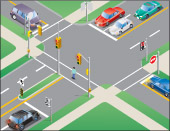
Along a heavily used main road, an intersection pedestrian signal lets people get across safely by telling vehicles to halt.
What an intersection pedestrian signal includes:
- A crosswalk, or several
- Walk and don't-walk indications for pedestrians
- Buttons that pedestrians press
- Traffic signals placed over the main road only
- The quieter side road, by contrast, is governed by stop signs
When you drive through intersections like these, follow every traffic rule and rely on sound, defensive driving habits.
Key takeaways
- White walking symbol = walk signal; pedestrians have right-of-way over all vehicles while crossing
- Flashing or steady orange hand = don't walk; do not begin crossing, but those already crossing still have right-of-way
- A flashing green, or a left-turn green arrow, does NOT permit pedestrians to cross
- Push-button pedestrian signals give more crossing time than regular traffic lights
- At intersection pedestrian signals, only the main road carries traffic lights, while the cross road uses stop signs
- As a driver, always be prepared to stop for pedestrians in crosswalks