Module 9/Lesson 1 of 3
Traffic Light Signals
Green, yellow, red lights, flashing signals, advance green arrows, transit priority signals, and what to do when lights fail.
What Traffic Lights Do
At intersections and along roadways, traffic lights direct both drivers and pedestrians on the actions they are required to take. The signals communicate when it is time to halt or proceed, how and when a turn is permitted, and when added caution is needed behind the wheel.
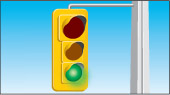
Green Light
On a green light, your options are to:
- Turn left
- Continue straight
- Turn right
But first you must yield to any vehicles and pedestrians who are already inside the intersection. Whenever your turn is to the left or the right, the right-of-way belongs to pedestrians who are crossing, so let them go first.

Yellow (Amber) Light
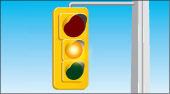
When the light turns yellow (also called amber), it is warning you that red is coming next. Stop if doing so is safe; if you cannot stop safely, carry on carefully.

Important
Amber is NOT a cue to accelerate. If you are able to halt safely, you are required to do so.
Red Light
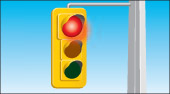
Red requires a full stop. Halt your vehicle completely at:
- The painted stop line, where one exists
- The crosswalk (whether or not it is painted) when no stop line is present
- The near edge of the sidewalk when no crosswalk exists
- The near edge of the intersection when no sidewalk exists either
Hold there until green returns and the intersection has cleared before you drive on.
Turning right on red: As long as no sign prohibits it, a right turn on red is permitted once you have stopped completely and confirmed the path ahead is clear.
Turning left on red: A left turn on red is allowed only when you are travelling from one one-way road onto another one-way road; even then, you must stop fully first and wait for a clear path.

Important
A LEFT turn on red is permitted in just one situation: going from one one-way road to another one-way road, and only once you have stopped fully.
Advance Green Light (Flashing Green) or Arrow
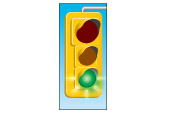
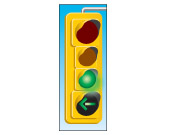
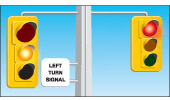
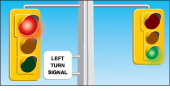
Two displays give you these permissions: a flashing green light, or a green light shown together with a green arrow that points left. When you see either one, you may:
- Turn left
- Continue straight
- Turn right (from the correct lane)
The reason this is known as an advance green light is that drivers coming toward you are still being held by a red signal. That gives you the right-of-way to make your left turn.
Pedestrians may NOT step off the curb on a flashing green light unless a separate pedestrian signal directs them to.


Tip
In Ontario, a flashing green signals an ADVANCE green: because the cars approaching from the other side are stopped at red, you hold the right-of-way to turn left.
Simultaneous Left Turn
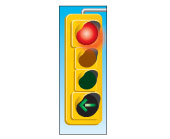
If a left-turn green arrow appears together with a red light, you are cleared to turn left out of the left-turn lane. Drivers facing you from the other side may be turning left at the same moment, since they have been given the same left-turn green arrow.
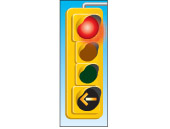
Once that green arrow ends, a yellow arrow can come on. It signals that the green light is about to show for one direction of traffic, or for both. Hold off on starting your left turn. Stop if it is safe to; if not, finish the turn carefully.
A left turn is still possible after the light goes green, but only with the path clear of both vehicles and people on foot. Should the light go red while you are already in the intersection, finish your turn once it is safe.
On a left-turn green arrow, pedestrians may NOT cross; the single exception is when a dedicated pedestrian signal tells them it is okay.


Fully Protected Left Turn
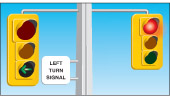
At certain intersections, left-turning drivers get their own dedicated signals, kept separate from the signals for traffic continuing straight or turning right.
Sequence:
- The left-turn lane is given a left-turn green arrow, while drivers going straight or turning right typically see red. You may now turn left, and oncoming drivers may be turning left as well.
- A yellow light then shows for the left-turning vehicles alone
- Next a red light shows for those left-turning vehicles only, at which point straight-through and right-turning traffic receives a green light or green arrows aimed straight ahead and to the right
Do NOT start a left turn once the through-traffic green has come on. If the signal changes to yellow while you remain in the intersection, finish your turn carefully.



Transit Priority Signals
At a transit priority signal, both drivers and pedestrians are required to give way to public transit vehicles. Mounted above a standard traffic signal, this round light displays a white vertical bar set against a dark background. It lets a transit vehicle continue straight or turn either direction while every conflicting movement is held at red.

Flashing Red Light
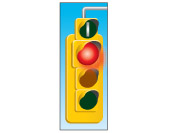
A flashing red light calls for a full stop. Proceed across the intersection only once it is safe to do so, handling it exactly as you would a stop sign.

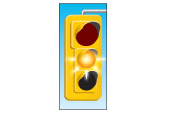
Flashing Yellow Light
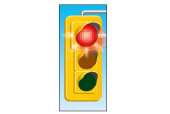
Where a yellow light is flashing, you are expected to approach and cross the intersection carefully.

Blank Traffic Lights (Power Failure)
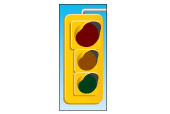
When power goes out, the traffic signals at an intersection stop functioning entirely.
- Give the right-of-way to any vehicle already in the intersection, as well as to one approaching from your right
- Proceed cautiously
- Handle the intersection exactly as you would one governed by all-way stop signs

Important
If a power failure has knocked out the signals, approach the crossing as though it were controlled by all-way stop signs.
Traffic Beacons
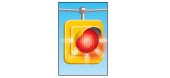
A traffic beacon is one flashing light on its own, suspended above an intersection or mounted over a sign or on a roadway obstacle.
- Flashing red beacon over an intersection or stop sign: a full stop is required, and you continue through only when it is safe
- Flashing yellow beacon over an intersection, a warning sign, or an obstruction: travel with caution



Key takeaways
- Green: go after yielding to traffic and pedestrians already in the intersection
- Yellow: stop if you safely can; otherwise proceed with caution -- it is NOT a signal to speed up
- Red: complete stop required; right turn on red allowed (unless signed) after a complete stop
- Left turn on red is only allowed when going from one one-way road onto another one-way road, after a complete stop
- Flashing green / green arrow with green = advance green -- oncoming traffic has a red light
- Flashing red = treat as a stop sign; flashing yellow = proceed with caution
- Blank traffic lights (power failure) = treat as an all-way stop
- Transit priority signal (white vertical bar) = yield to transit vehicles
- In a fully protected left turn, do NOT begin turning left after the through-traffic green appears