Module 7/Lesson 4 of 6
Rain, Fog, Snow & Skids
Driving safely in adverse weather conditions including rain, fog, snow, ice, whiteouts, and how to handle skids.
Driving in Rain
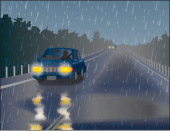
Rain turns the road surface slick, and the danger is highest just as the first drops land. As the rain keeps falling, your tires grip the pavement less and less. Push through too much water, or simply drive too fast, and your tires can start riding across the surface of the water the way water skis do -- a phenomenon known as hydroplaning -- at which point steering and control get very hard to maintain.
Tips for driving in rain:
- Be sure your tires are good ones with plenty of tread depth
- Slow your pace once the pavement is wet
- Aim for the drier patches of road; look well ahead and plan your moves
- Keep your steering, braking, and acceleration smooth to lower the risk of a skid
- Open up extra space between you and the car in front
- Stay out of puddles -- one can conceal a deep pothole, the spray can block other drivers' view, and the water can sap your braking power
- Confirm your wiper blades are in good shape, and swap out any that leave streaks

Flooded Roads
Steer clear of flooded roads -- the water can keep your brakes from working at all. If a flooded stretch is unavoidable, check your brakes once you're through to dry them off.
How to test your brakes:
- When it's safe, brake quickly and firmly from 50 km/h
- Confirm the car pulls up in a straight line and doesn't drift to one side
- The pedal should feel firm and solid, never spongy -- a spongy feel signals a problem
- If the car still pulls to a side, or the pedal still feels spongy, even after the brakes have dried, take it in for repair without delay
Warning
Whenever you've driven through standing water, test the brakes afterward. A spongy pedal, or pulling to one side, calls for repair right away.
Driving in Fog
Fog is a shallow layer of cloud sitting at ground level, and it can slash visibility dramatically. Your best move is simply not to drive in it -- look at the weather forecast and put off your trip whenever a fog warning is in effect.
DO:
- Bring your speed down gradually and drive at whatever pace the conditions call for
- See that your entire lighting system is switched on
- Run your low beams (high beams bounce off the moisture droplets and make seeing harder)
- If your car has fog lights, run them on top of your low beams
- Be patient -- skip passing, lane changes, and crossing traffic
- Let the pavement markings steer you, leaning on the right edge of the road as your guide instead of the centre line
- Stretch out your following distance to give yourself more braking room
- Watch and listen for whatever hazards lie ahead
- Keep windows and mirrors clear, using the defroster and wipers
- If the fog gets too thick, pull right off the road into a safe parking spot and turn on your emergency flashers along with your low beams
DON'T:
- Don't halt on the part of the road still being driven -- you risk becoming the first car in a chain-reaction pileup
- Don't suddenly accelerate just because the fog looks to be thinning -- you could plunge straight back into it
- Don't speed up to get past a slow vehicle or to shake off a tailgater
Important
In fog, low beams are the only headlights to use. High beams reflect back off the moisture and make it even harder to see.
Driving in Snow
Snow can be packed down and as slick as ice, churned into hard ruts and gullies, or soft and smooth. Look well ahead and work out what you'll need to do based on what the surface is doing.
- Slow down where the snowy road is rutted
- Steer, brake, and accelerate gradually -- any sudden input can set off a skid
- Keep cruise control OFF in snow and other rough weather
Warning
Never rely on cruise control in snow or other rough weather -- you want full, instant command over your acceleration.
Whiteouts and Blowing Snow
Snow blowing across the road can produce whiteouts that wipe out your view of it entirely. When blowing snow is in the forecast, drive only if you truly must, and then with the greatest care.
DO:
- Bring your speed down gradually and match it to the conditions
- Switch on the full lighting system
- Run your low beams (high beams bounce off the airborne ice crystals and make seeing harder)
- Add your fog lights to the low beams
- Be patient -- skip passing, lane changes, and crossing traffic
- Lengthen your following distance
- Stay sharp and keep your eyes as far down the road as you can
- Keep windows and mirrors clear
- When visibility drops to almost nothing, try to leave the road and pull into a safe parking spot
DON'T:
- Don't stop on the part of the road still in use
- Don't try to pass a slow-moving vehicle or floor it to outrun a tailgater
If you end up stuck or stranded in severe weather:
- Stay put with the vehicle, where it's warmest and safest, until help reaches you
- Crack a window open a little for fresh air
- Run the engine only now and then
- Switch on your emergency flashers
- Plan ahead by packing a winter driving survival kit -- warm clothes, non-perishable energy foods, a flashlight, a shovel, and a blanket
Driving on Ice and Black Ice
Once temperatures fall below freezing, wet roads turn icy. The first places to freeze are shaded stretches and the surfaces of bridges and overpasses. Look ahead, ease off your speed, and expect ice.
Black ice: When the road ahead has the look of shiny black asphalt, treat it with suspicion -- a thin film of ice may be coating it. As a rule, winter asphalt ought to appear gray-white. If you suspect black ice up ahead, slow down and proceed carefully.
Tip
Bridges, overpasses, and shaded spots ice over first. In winter, asphalt that looks shiny and black rather than gray-white should make you suspect black ice.
Snow Plows
Snow-removal vehicles working public roads carry flashing blue lights that are visible from 150 metres away.
- To the plow's right, a wing can stick out as much as three metres from the vehicle's side
- Out on freeways you may find several plows arranged in a staggered line across the road, clearing every lane at once as they hand a ridge of snow from one plow to the next
- Don't attempt to slip between staggered snow plows -- there simply isn't room, and the ridge of wet snow can send your vehicle out of control
Warning
Never try to squeeze between staggered snow plows on a freeway. The ridge of snow piled between them can wrench your vehicle out of control.
Understanding and Handling Skids
A skid sets in when one or more tires lose their hold on the road. They turn up most often on slippery footing -- pavement that's wet, icy, or coated with snow, gravel, or other loose stuff. The leading cause is simply driving too fast for the conditions. Slamming the brakes and steering, turning, or accelerating too aggressively can trigger one as well.
To avoid a skid:
- Keep your speed down on slippery roads
- Work the controls in a smooth, light-handed way
- Don't brake or accelerate mid-turn -- doing so nudges the tires nearer to a skid
- Take your turns gently
If your vehicle starts to skid:
- Stay calm -- holding control is still possible
- Lift off the accelerator or the brake
- On a really slick surface, shift into neutral if you're able
- Keep steering toward where you want the car to go
- Take care not to oversteer
- After you've regained control, apply the brakes as needed -- very gently and smoothly
Anti-Lock Braking Systems (ABS)
ABS works by monitoring how fast each wheel is turning while you brake. The moment a wheel starts to lock, the system eases the braking force on that wheel, which stops the tire from skidding and keeps you able to steer.
Key points about ABS:
- ABS keeps wheels from locking and helps you hold steering control
- Don't count on it to shorten your stopping distance
- During hard braking you may sense the brake pedal pulsing -- that's perfectly normal
- Know to expect that pulsing so it doesn't rattle you or tempt you to let off the pedal in an emergency stop
- Rehearse emergency braking in a controlled setting with a qualified driving instructor
With ABS: Push the brake pedal down hard and let the system manage the wheel lock-up on its own.
Threshold Braking (Non-ABS Vehicles)
In a vehicle that has no ABS, threshold braking lets you make a fast, controlled stop even on slippery footing:
- Brake as forcefully as you can right up until a wheel starts to lock
- Ease off the pedal a little to free that wheel
- Push back down, putting on as much braking force as you can without setting off a skid
- Whenever you feel a wheel begin to lock, ease off slightly and reapply
- Don't pump the brakes -- keep up steady, modulated pressure
- Carry on this way until you've slowed to the speed you want
Key takeaways
- Hydroplaning is your tires riding atop the water -- slow down and keep deep tread on your tires
- Once you've driven through standing water, test the brakes from 50 km/h
- In fog, run low beams rather than high beams, track the right road edge, and lengthen your following distance
- Keep cruise control off in snow or rough weather
- Stuck or stranded in a whiteout, stay with the car, crack a window, and run the engine only occasionally
- Bridges, overpasses, and shaded areas ice over first; shiny black asphalt may be hiding black ice
- Snow plows carry flashing blue lights -- never squeeze between staggered plows on a freeway
- Driving too fast causes most skids -- when one starts, lift off the pedal and steer toward your target
- ABS stops wheels locking but won't shorten your stopping distance; press the pedal hard and keep it there
- In a vehicle without ABS, use threshold braking and don't pump the brakes