Module 7/Lesson 3 of 6
Night Driving & Glare
How to drive safely at night, manage headlight glare, and avoid overdriving your headlights.
Driving at Night
After dark, and in conditions like rain, snow, or fog, your view of the road ahead shrinks even with your headlights on. Ease off the gas when you drive at night, above all on roads without lighting and any time the weather cuts into how far you can see.
Overdriving Your Headlights
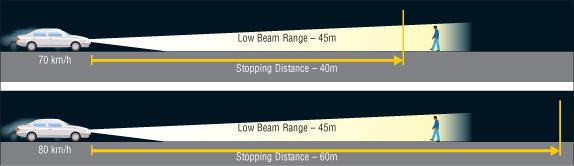
Overdriving your headlights means travelling fast enough that the distance you need to stop stretches beyond the range your headlights actually light up. That's risky, because you may leave yourself too little room to come to a safe halt.
Reflective road signs can fool you too, giving you the impression that you can see farther than you genuinely can -- and that impression can lead you straight into overdriving your headlights.

Warning
Keep your speed slow enough that you can stop inside the patch of road your headlights light up. The moment you can't pull up within that lit zone, you're driving too fast.
Dealing with Glare
Glare is blinding light that makes it tough to see clearly and to keep track of what the people around you are doing. It can crop up on sunny days and overcast ones alike, depending on the angle the sun's rays strike and what's around you. At night it becomes an issue too, whenever bright headlights are facing you or bouncing back at you from the rearview mirror.
Coping with nighttime glare from oncoming traffic:
- Direct your eyes up and past the oncoming lights and a little to the right of them
- Never lock your gaze onto the approaching headlights
Coping with daytime glare:
- Flip down your sun visor
- Stash a good pair of sunglasses in the car
- Entering a tunnel when the day is bright, ease off your speed to give your eyes time to adapt, slip off your sunglasses, and switch on your headlights
Headlight rules that cut glare for everyone else:
- Switch to low beams once you're within 150 metres of an oncoming vehicle
- Switch to low beams when you're following another vehicle within 60 metres
- Out on country roads, drop to low beams as you reach a curve or crest a hill, so you can pick up oncoming headlights and avoid dazzling the drivers behind them
- When no oncoming headlights are in view, flip back to high beams
Tip
Two distances worth memorizing: drop to low beams within 150 m of oncoming traffic and within 60 m when you're following someone.
Key takeaways
- Slow down after dark -- even your headlights only show you so far ahead
- You're overdriving your headlights when the distance you need to stop runs past what you can actually see
- Faced with oncoming high beams, aim your eyes up, beyond, and a touch to the right
- Go to low beams within 150 metres of oncoming traffic and within 60 metres of the vehicle in front of you
- On country roads, drop to low beams at curves and hilltops so you can spot oncoming traffic
- Driving into a tunnel when it's bright out, ease off your speed, take off your sunglasses, and switch on your headlights