Module 7/Lesson 2 of 6
Construction Zones & Emergency Vehicles
Rules for driving through work zones, dealing with animals on the road, and yielding to emergency vehicles.
Workers on the Road (Construction Zones)
Take extra care any time you pass through a construction zone or a stretch where crews are working on or beside the roadway.
When approaching a construction zone:
- Slow to a cautious pace and follow every warning sign, person, and device guiding traffic through the area
- Reduced speed limits are frequently posted to keep workers safer and account for the extra hazards present -- construction vehicles, gravel or uneven surfaces, and pinched-in lanes
- Drive carefully and match your driving to whatever the conditions demand
- Hold your lane -- this is no place to switch lanes
- Stay ready to stop without warning
- Keep an eye out for workers as well as the construction vehicles and equipment sharing the road
Traffic-control workers steer vehicle traffic through work zones. Day or night, look out for them and do as they direct.
Show respect to the crews working on the road, and keep your patience if traffic backs up. There are times when one direction of traffic has to hold while the oncoming side clears a detour. When your lane is blocked and nobody is directing traffic, give way to whoever is coming toward you.
Important
When workers are on site, the fines for speeding through a construction zone are DOUBLED. It's likewise an offence to ignore the STOP or SLOW signs that a traffic-control worker or firefighter holds up.
Other Workers and Vehicles on the Road
You may also come across other kinds of workers and vehicles on the road that present a hazard, such as:
- Disabled vehicles and roadside assistance crews
- Surveyors
- Utility or road-maintenance workers
Always ease off the gas and pass carefully so you don't cause a collision. Where it's safe, shift over a lane to put more room between yourself and the hazard.
Animals on the Road
Collisions with animals -- moose and deer in particular -- are becoming more common. Between 1999 and 2008, motor vehicle crashes involving wild animals climbed from 8,964 to 12,791, a jump of 43% across that decade, and plenty more go unreported.
Anywhere in Ontario, you might meet domestic, farm, or wild animals on the roadway. Sweep your gaze across the road ahead from one shoulder to the other. A great many regions post animal crossing signs to warn of large animals such as moose, deer, and cattle -- take them seriously, particularly during the dusk-to-dawn window when wildlife is at its most active.
To cut down on the odds of striking an animal:
- Ease off the speed in the dark and in rain or fog
- Keep your pace safe and your attention sharp -- speeding and inattention are the usual culprits
- Look for eyes reflecting light at the road's edge; when you spot any, slow down and be ready to halt
- Keep the windshield clean and the headlights aimed correctly
- Run your high beams wherever it's safe to do so, scanning both verges of the road
If an animal appears:
- Slow down and give your horn a sound
- Stay watchful for additional animals that may be travelling with it
- Resist any urge to steer around it -- you can't predict how an animal will move
- Want to stop and watch one? First pull right off the road entirely and park (not on the shoulder)
- Remain inside your vehicle -- stepping out raises your odds of being struck by passing traffic
- Should you hit a deer or moose, get word to either your local police or the Ministry of Natural Resources. Never attempt to move an injured animal yourself.
Types of Emergency Vehicles
You can recognize an emergency vehicle -- whether it's a police car, a fire truck, an ambulance, or a special public-utility vehicle -- by:
- Red or blue lights that flash
- A bell or siren
- White headlamp high beams flashing in an alternating pattern
Keep in mind that police, fire, and ambulance services run a wide assortment of vehicles -- motorcycles, trucks, buses, snowmobiles, all-terrain vehicles, and even bicycles among them.
Note: When firefighters and volunteer medical responders use their personal vehicles to answer an emergency, some display a flashing green light. Let them have the right-of-way so they can reach the scene quickly and safely.

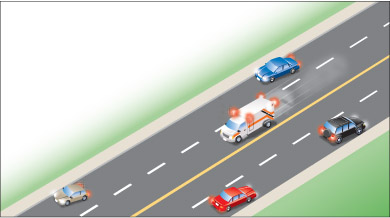
Reacting to an Approaching Emergency Vehicle
Whenever an emergency vehicle bears down on you from any direction -- flashing red lights (or a red-and-blue combination), or sounding its siren or bell -- you must stop your vehicle right away.
How to stop properly:
- Get as near as is practical to the road's right-hand curb or edge
- If you're on a one-way street or a divided highway of more than two lanes, head for the nearest curb or edge instead
- Keep your vehicle parallel to the roadway and out of any intersection, on/off ramps included
- Steer clear of the shoulder and never stop on it -- emergency vehicles may be using it to travel
Stopping safely:
- Check ahead, to both sides, and behind you
- Flag your intention to pull over with plenty of lead time
- Start matching your speed to the traffic on the side you're heading toward
- Slow down with gentle, gradual braking, steering smoothly and without overdoing the brakes
- Watch for any vehicle bearing down quickly from behind
If you're in an intersection getting ready to turn:
- Cancel the turn and clear the intersection by going straight once it's safe
- Then move to the right and stop
Once the emergency vehicle has gone by:
- Confirm the way is clear and signal before you rejoin traffic
- Keep watching for any further emergency vehicles
Important
Tailing a fire vehicle that's responding to an alarm any closer than 150 metres is against the law.
Passing a Stopped Emergency Vehicle or Tow Truck
As you come up behind a stopped emergency vehicle whose red lights -- or red-and-blue lights -- are flashing, or a tow truck flashing amber lights, while the two of you head the same way:
- Slow down and continue with care
- Gauge how fast the surrounding traffic is moving and what the road is doing (fog, rain, snow)
- Begin braking early and gradually
On a road with two or more lanes going your direction:
- You must shift over into a lane farther from the emergency vehicle or tow truck, provided it's safe
- Flick on your turn signal before you move across
- Recheck your mirrors and your blind spots
- Make the lane change with plenty of distance to spare before you reach the stopped vehicle
Tips to remember:
- Stay focused, cut out distractions, and keep the cabin quiet
- Keep calm -- no abrupt lane changes and no heavy braking
- Before you alter your direction or speed, weigh the road conditions, scan nearby traffic, check your mirrors, glance at your blind spots, and signal and brake with plenty of lead time
- Leave the shoulders, intersections, and highway ramps open for emergency vehicles to use

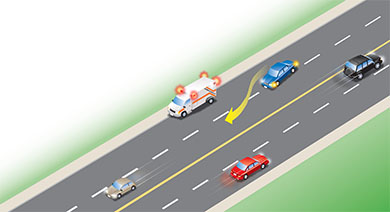
Warning
Don't stop for an emergency vehicle and a first offence can cost you a fine plus 3 demerit points. Repeat offences carry bigger fines and as much as six months in jail. Tow trucks with flashing amber lights are covered by the very same fines and penalties.
Being Pulled Over by Police
A police officer or other enforcement officer can order you to pull over and stop. Usually the officer signals this by following you with emergency lights flashing and/or siren on, or by waving you over with hand gestures from the roadside.
When being pulled over:
- Stop clear of the traffic lanes and on the shoulder wherever that's possible
- If a quieter side street is right nearby, you may turn onto it and stop there
- Should the officer indicate where they want you to stop, do as they direct
Key takeaways
- Speeding fines double in a construction zone whenever workers are on site
- Hold your lane while you're inside a construction zone
- Wildlife is busiest from dusk to dawn -- look for reflecting eyes and heed animal crossing signs
- Don't steer around an animal; there's no telling which way it will dart
- Any emergency vehicle with flashing lights or a siren, from any direction, means you stop at once
- Pull over to the right-hand curb, keep parallel to the road, and stay out of intersections
- Keep off the shoulder when you stop -- emergency vehicles may need it
- On a multi-lane road you're required to move over a lane for stopped emergency vehicles and tow trucks
- Following a fire vehicle answering an alarm closer than 150 metres is illegal
- Ignore an emergency vehicle and a first offence brings a fine plus 3 demerit points; repeat offences mean larger fines and up to 6 months in jail