Module 6/Lesson 1 of 2
Entering & Driving on Freeways
Learn what defines a freeway, who is allowed to use one, the ramp-and-acceleration-lane method for getting on, and the habits that keep you safe at highway speeds.
What is a Freeway?
A freeway -- which you may also hear called an expressway -- is a multi-lane road built for high speeds. Its defining features:
- The two directions of travel are kept apart from each other
- Ramps are the only way vehicles get on and off
- Because vehicles move faster here than elsewhere, the driving demands more of you
- You won't find intersections, cyclists or pedestrians, and that absence can actually make these roads safer once a driver has experience
Someone new to driving should first get comfortable handling traffic at lower speeds before taking on the freeway. A Class G1 driver is permitted on a freeway only when a licensed driving instructor is in the vehicle.
Important
A G1 driver may use a freeway ONLY when accompanied by a licensed driving instructor. Apart from that, G1 holders are barred from 400-series highways and several other high-speed routes.
Entering a Freeway
A freeway entrance normally has two parts:
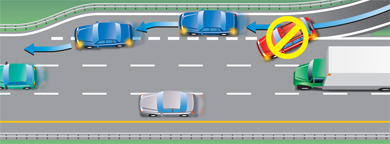
- Entrance ramp: While you travel along it, scan ahead and glance at your mirrors and blind spots so you can read the traffic and spot the gap in the closest freeway lane where you'll merge.
- Acceleration lane: This is the stretch you reach after leaving the ramp. Use it to build your speed up to whatever the freeway traffic is doing before you join it. Put your signal on and pick up speed so the merge is smooth.
Important: Drivers already on the freeway should shift over when it's safe, opening up room for vehicles that are merging.
Some ramps feed onto the freeway from the left instead. In that case the fastest lane is the one you join first, so accelerate harder in the acceleration lane to reach traffic speed.

Tip
Use the acceleration lane to match freeway speed BEFORE merging. Do not try to merge at a much slower speed than the flow of traffic.
Driving Along a Freeway
After you've merged on, careful drivers tend to:
- Hold a steady speed
- Keep their eyes forward and predict what the road ahead may do
- Stay to the right, reserving the left lanes for overtaking
- Keep their gaze moving constantly -- forward, to either side, and behind
- Project where they'll be roughly 15 to 20 seconds from now, or as distant as visibility allows once speeds climb
- Glance at the mirrors often
Space and Safety on Freeways
- Keep your distance from big vehicles -- their bulk hides more of the road from you than smaller ones do
- Maintain a cushion of open space on all sides so you have both the time and the room to respond
- Take care never to cut anyone off while changing lanes or joining traffic -- a slower vehicle pulling in front of a faster one is both hazardous and against the law
- The far left lane is for overtaking traffic that's below the limit, but don't linger in it
- Where a freeway has three or more lanes, large trucks are not allowed in the far left lane and have to pass from the lane just to its right
- Make a habit of staying in the right-hand lane, leaving the rest open for passing
Important
Drive in the right lane when possible. The left lane is for passing. On 3+ lane freeways, trucks must use the middle lane to pass, not the far left.
Key takeaways
- Freeways are fast, multi-lane roads that carry no intersections, cyclists or pedestrians
- A G1 driver is allowed on a freeway only with a licensed driving instructor aboard
- Build up to traffic speed in the acceleration lane before you merge
- Project where you'll be 15-20 seconds down the road and glance at your mirrors often
- Keep to the right lane; treat the left lane as a passing lane and move back over afterward
- Don't cut off another vehicle when merging -- a slower car must never pull in front of a faster one
- On a freeway with three or more lanes each way, large trucks are barred from the far left lane