Module 6/Lesson 2 of 2
Exiting Freeways & HOV Lanes
Getting off a freeway safely, the hazard of speed adaptation, and the rules that govern High Occupancy Vehicle (HOV) lanes.
Leaving a Freeway
A freeway exit is generally made up of three parts:
- Deceleration lane: Where you bleed off speed, carrying you away from the main stream of traffic
- Exit ramp: The link between the freeway and the road that crosses it
- Intersection: Found at the ramp's end, where a traffic light, yield sign or stop sign controls it
How to exit:
- Signal your move into the deceleration lane -- but hold your speed for now
- Once you're in that lane, ease off gradually down to the speed posted for the exit ramp
- Glance at the speedometer -- it's easy to misjudge how fast you're actually travelling
- Be ready to come to a stop where the ramp ends

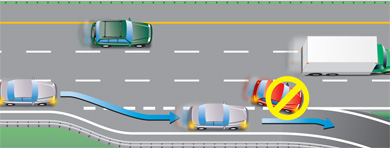
Warning
Do NOT slow down before entering the deceleration lane. Reduce speed only after you are in the deceleration lane.
Speed Adaptation (Velocitization)
Spend a while at freeway speeds and your sense of how fast you're moving can stop being reliable. That effect goes by two names: speed adaptation and velocitization.
It poses a particular hazard as you leave a freeway because:
- Your speed can feel far slower than it really is
- Always glance at the speedometer on the way off, confirming you've slowed enough for both the ramp and the intersection waiting at its end
Important
Speed adaptation (velocitization) makes you think you are going slower than you are after highway driving. Always check your speedometer when exiting a freeway.
If You Miss Your Exit
Exit signs are posted with enough lead time that you can change lanes without rushing.
If you go past your exit:
- Never stop on the freeway
- Never back up on the freeway
- Just carry on to the following exit
Warning
NEVER stop or reverse on a freeway if you miss your exit. Continue to the next exit.
High Occupancy Vehicle (HOV) Lanes
Picture a High-Occupancy Vehicle (HOV) lane as a purpose-built lane set aside for particular vehicles that carry a required number of people on board. Drivers who carpool or ride transit can save travel time by using one.
The benefits reach every road user, not just carpoolers:
- Carrying more people in fewer vehicles makes better use of the highway network
- Fewer vehicles end up on the road overall
- Total emissions drop and air quality gets better
These lanes operate around the clock, every day of the week.
HOV Lane Rules
On provincial highways, the HOV lane is set aside for vehicles holding two or more people (a driver and at least one passenger) among these vehicle types:
- Cars
- Minivans
- Motorcycles
- Pickup trucks
- Buses
Key rules:
- A striped buffer zone divides the HOV lane from the ordinary traffic lanes, and crossing those striped pavement markings is both against the law and dangerous.
- Get in and out of an HOV lane only where the marked entry/exit zones allow it.
- Misuse the lane and a police officer can pull you over and issue a ticket; you'll then be told to merge back into general traffic at the following entry/exit zone.
Important
HOV lanes require at least 2 people in the vehicle (driver + 1 passenger). It is illegal to cross the striped buffer zone -- use only designated entry/exit zones.
HOV Lane Exemptions
A handful of vehicles get a pass from the HOV occupancy rules:
- A bus may travel in an HOV lane whenever it likes, no matter how many people are aboard
- Emergency vehicles -- police, fire and ambulance -- are exempt
- Taxis and airport limousines carrying only the driver are allowed in
- A vehicle bearing a "Green" licence plate can use the lane with however many people are inside (these plates go to qualifying plug-in hybrid electric vehicles, as well as to full-battery electric vehicles)
To run in the HOV lane, a commercial motor vehicle has to:
- Carry two or more occupants, AND
- Measure under 6.5 metres end to end.
Tip
Green licence plate vehicles (eligible plug-in hybrids and full-battery EVs) can use HOV lanes with any number of occupants, including solo drivers.
Key takeaways
- A freeway exit is made of three parts: a deceleration lane, an exit ramp, and an intersection
- Hold your speed until you've actually reached the deceleration lane
- Speed adaptation (velocitization) throws off your sense of speed after highway driving -- glance at the speedometer
- If you overshoot your exit, don't stop or back up -- just continue to the next one
- HOV lanes need a minimum of 2 occupants and run 24/7
- Crossing the HOV striped buffer zone is illegal -- enter and leave only at marked entry/exit zones
- Buses, emergency vehicles, taxis, airport limos and Green licence plate vehicles are excused from HOV occupancy rules
- A commercial vehicle in an HOV lane needs 2+ people and must be under 6.5 metres long