Module 8/Lesson 1 of 4
Regulatory Signs
Stop signs, yield signs, speed limits, parking restrictions, lane controls, and other mandatory signs you must obey.
Understanding Traffic Signs
Every sign on the road does one of three jobs: it tells you the law, flags a hazard, or points you toward your destination. To make each one quick to recognize, signs rely on a mix of distinctive shapes, colours, and symbols.
Signs fall into four broad categories:
- Regulatory signs -- set out instructions you are required to follow
- Warning signs -- alert you to hazards or unusual conditions coming up
- Temporary condition signs -- flag construction zones, diversions, and detours
- Information and direction signs -- guide you to destinations and report distances
Stop Sign
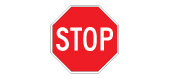
With its eight sides, red background, and white lettering, the stop sign tells you to bring your vehicle to a full halt.
Where to stop:
- At the stop line if one is painted on the road surface
- With no stop line present, at the crosswalk
- With no crosswalk either, at the edge of the sidewalk
- With no sidewalk at all, at the edge of the intersection
Hold your position until the road is clear, then proceed into the intersection.

School Zone Sign
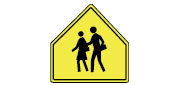
Shaped with five sides and printed on a fluorescent yellow/green background with black symbols, this sign signals that a school zone lies ahead. Ease off the gas, take extra care, and keep an eye out for children.

Yield Sign
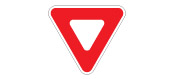
The yield sign takes the form of a triangle with a white face and red edge. It requires you to give the right-of-way to vehicles already in the intersection, or approaching it, before you proceed. Come to a stop if you have to, and move only once the road is clear.

Railway Crossing Sign
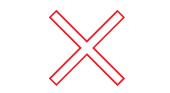
Built in the shape of an X with a white face and red border, this sign tells you that railway tracks cut across the road ahead. Keep an eye out for it, ease off your speed, scan both directions for trains, and be ready to come to a stop.

Common Regulatory Signs
Regulatory signs spell out instructions that drivers are required to follow. Most are square or rectangular, carrying a white or black background with letters in black, white, or colour.
- A green circle tells you that you MAY or MUST do whatever it frames
- A red circle crossed by a line marks an activity that is NOT permitted
Regulatory signs you'll see often include:
- Bicycle route -- expect cyclists and be ready to share the road with them
- Parking permitted -- parking is allowed between the paired signs during the hours posted
- Snowmobiles may use this road
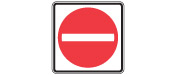
- Do not enter -- this road is closed to your vehicle
- No stopping -- between the paired signs you may not stop at all, not even briefly
- No standing -- between the paired signs, stopping is allowed only to pick up or drop off passengers
- No parking -- between the paired signs, stopping is allowed only to load or unload passengers or goods
- No left turn / No right turn on red / No U-turn / No through traffic
- No left turn during the hours posted
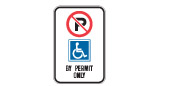
- Accessible parking -- reserved for vehicles showing a valid Accessible Parking Permit
- No bicycles / No pedestrians
- Keep right of traffic island
- Speed limit changes ahead
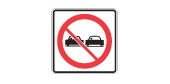
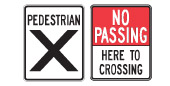
- Do not pass
- Slow traffic keep right on roads with multiple lanes



Pedestrian Safety Zone and School Zone Speed Signs
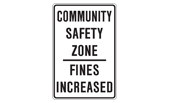
- Community Safety Zone -- marks stretches the community has flagged as carrying a heightened danger to pedestrians. Any traffic offence committed inside the zone draws steeper fines.
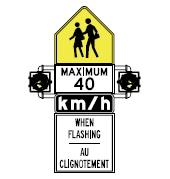
- School zone speed limit -- a reduced limit applies while school is in session. Stick to the posted figure whenever the yellow lights are flashing.
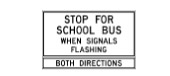
- Stop for school bus -- come to a stop while its signals flash
- School bus stop ahead (multi-lane) -- where a multi-lane highway has no centre median dividing it, traffic from both directions must halt for a school bus whose lights are flashing



Lane Control and Direction Signs
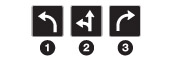
- Lane direction signs (mounted over the road or painted on the surface) show which way each lane must go -- left turn, straight ahead, or right turn
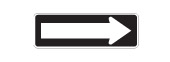
- One-way traffic -- vehicles may move in a single direction only
- Pedestrian crossover -- be ready to halt and give pedestrians the right-of-way
- Two-way left-turn lane -- this lane handles left turns from both directions only
- Accessible loading zone -- a stretch of curb set aside for vehicles with an Accessible Parking Permit dropping off or picking up passengers
- Reserved lanes -- lanes set aside for particular vehicle types (buses, taxis, vehicles with three or more occupants, bicycles), whether around the clock or only at posted hours
- Keep right except when passing on two-lane stretches that provide climbing or passing lanes
- Yield to bus -- posted on the rear of transit buses to remind drivers to let a bus pull away from a dedicated stop
- Road forks to the right
- School bus loading zone -- an area where school buses pick up and drop off without switching on the red alternating lights or extending the stop arm



Key takeaways
- Stop sign: eight-sided, red -- come to a complete stop at the stop line, crosswalk, sidewalk edge, or intersection edge
- Yield sign: triangle, white with red border -- let traffic in the intersection go first
- School zone sign: five-sided, fluorescent yellow-green -- slow down and watch for children
- Railway crossing: X-shaped, white with red outline -- slow down and look both ways for trains
- Green circle = activity permitted; red circle with line = activity prohibited
- Community Safety Zones have increased fines for traffic offences
- On multi-lane highways with no median, drivers from both directions must stop for school buses
- Regulatory signs must be obeyed -- they are not suggestions